


Yes, a digital marketing agency can work with an in-house team: keep business priorities and final approval inside your company, and assign the agency clearly defined work such as paid media, SEO or content production. The trade-off is coordination time; external support still needs an internal owner, useful briefs and access to the information required to deliver.
- Can a digital marketing agency work with an in-house team? Yes—give each deliverable a named owner and approver.
- Keep commercial priorities and brand approval in-house; assign paid media, SEO or content production against a written scope.
- ReachDigital offers digital marketing services for property companies, e-commerce brands, consumer brands and medical services.
- Choose specialist support for a skills gap; choose campaign support for a defined launch.
Can a digital marketing agency work with an in-house team?
Yes. Divide responsibility by deliverable, not by who has the loudest opinion. Your internal team brings business knowledge, customer feedback and commercial priorities; the agency takes responsibility for the agreed specialist work.
ReachDigital provides social media management, paid digital media, content production, SEO and digital campaign development. Select the service that fills a specific gap rather than duplicating a role your team already handles well.
Use this comparison to decide how to structure the relationship in 2026. These are proposed working arrangements, not named agency packages.
| Working arrangement | Best for | Keep in-house | Assign externally | Main advantage | Main limitation |
|---|---|---|---|---|---|
| Specialist support | A clear channel skills gap | Priorities, brand approval and customer knowledge | Defined paid media, SEO or social media work | Adds focused expertise without transferring every marketing task | Requires coordination with your other channels |
| Production support | A team with direction but insufficient production capacity | Messaging, briefs and approval | Agreed content production | Gives your team a defined production resource | Weak briefs still create revisions |
| Campaign support | A launch with a clear objective | Commercial decisions and final sign-off | Agreed campaign development and delivery | Connects external work to a specific business initiative | Needs clear boundaries with ongoing marketing |
An agency cannot replace decisions only your business can make. Before choosing an arrangement, identify whether the actual gap is expertise, execution capacity or internal decision-making.
Why this matters
Hiring external help does not remove the need to manage marketing. It changes what your team manages: less hands-on execution in the assigned area, more briefing, approval and commercial feedback.
For your 2026 marketing plan, separate those responsibilities before expanding activity. If your marketing lead already struggles to secure decisions, adding another delivery team leaves that approval problem unresolved.
A useful partnership gives your employees work they can genuinely own. It should not leave them checking every agency action while still doing the original job themselves.
Specialist support: keep direction, delegate channel execution
Best for: an internal team that understands the business but needs help with a specific channel. Keep campaign priorities and brand decisions with your marketing lead, then assign a defined channel scope to the agency.
For paid digital media, specify who prepares creative, who approves targeting and who authorises changes to spending. For SEO, establish who recommends website changes, who implements them and who approves published copy.
The advantage is a narrow, understandable division of labour. The limitation is that channel work still depends on assets, website changes and feedback from people outside the agency.
Do not appoint an agency to own a result while withholding authority over the work required to pursue it. If website implementation stays internal, give that task an internal owner and include it in the delivery plan.
Production support: keep the message, assign the making
Best for: a team with an agreed content direction but insufficient capacity to produce it. Your employees supply the audience insight, product information and approved messaging; the agency handles the agreed production deliverables.
Write down what finished work means. A brief should distinguish between an initial concept, an approved asset and a file ready for publication, with responsibility assigned at each handover.
Production support offers a clear task boundary. Its limitation is dependence on the quality of the source material: an agency cannot resolve conflicting product information or approve a claim on your behalf.
For a 2026 content plan, keep a shared list of approved messages and reusable assets. That gives both teams a reference point when reviewing new work instead of reopening the same brand discussion with every brief.
Campaign support: organise around a defined objective
Best for: a business launching a specific campaign while its internal team maintains ongoing marketing. Define the campaign objective, its deliverables and the handover back to regular activity before work starts.
For example, a property company can retain responsibility for development information and sales feedback while assigning campaign development externally. An e-commerce brand can retain product priorities and customer service while assigning agreed creative or paid media work.
The advantage is a focused assignment. The limitation is the boundary between campaign activity and ongoing work: somebody must decide which team handles overlapping messages, audience activity and website requests.
Give campaign decisions a clear approval route. A launch date is not permission for either team to bypass brand, commercial or professional review.
How do you set up the partnership?
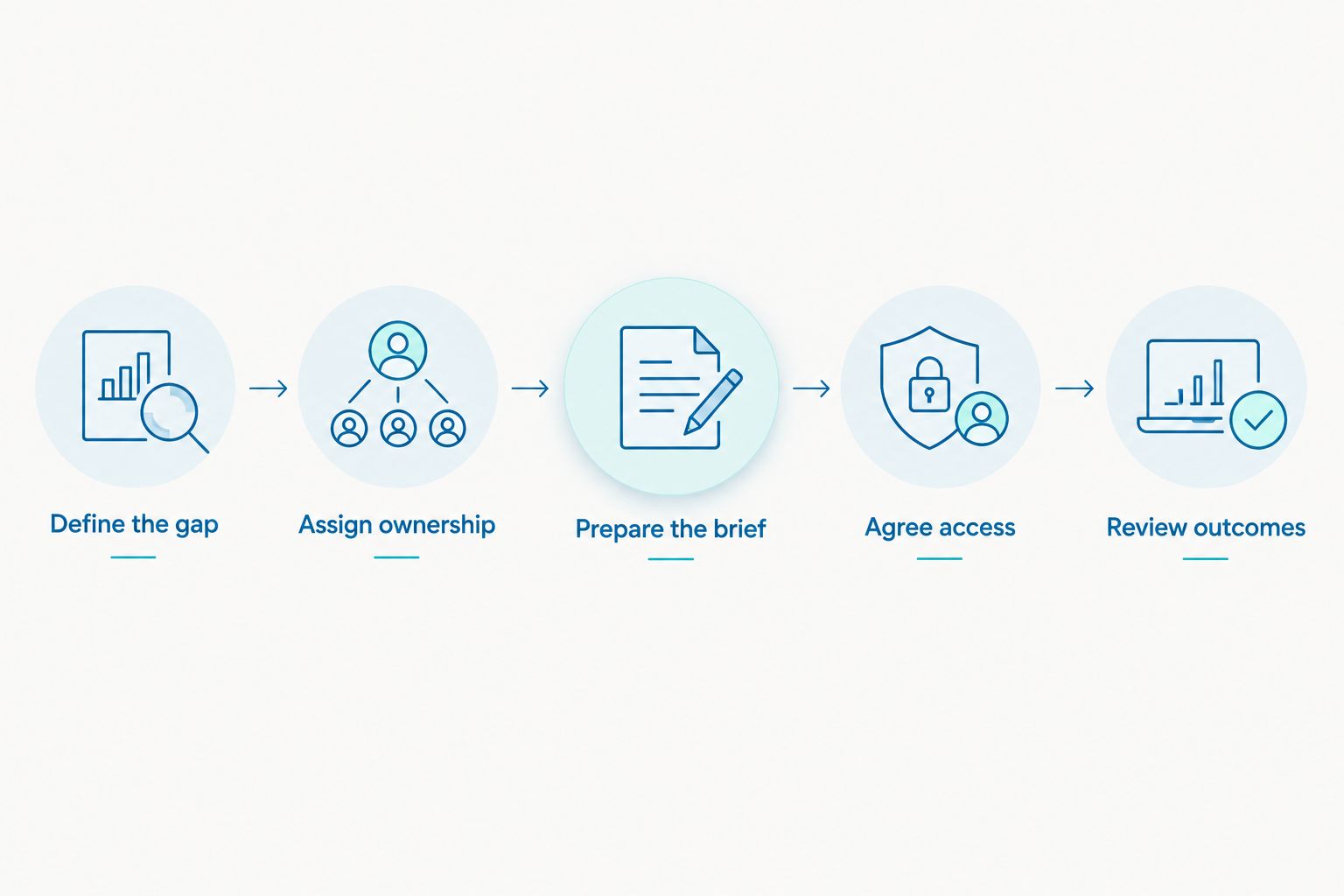
Build the workflow around decisions and handovers, not a long list of meetings. Use these steps to make responsibilities visible before the first deliverable arrives.
1. Define the gap
Write one sentence explaining why you need external support. Name the missing capability or blocked work, such as paid media execution, SEO recommendations or content production.
Then list what your team will continue doing. This prevents a narrow appointment from becoming an undefined expectation that the agency will handle everything digital.
2. Assign ownership
For each deliverable, name the person producing it, the person approving it and any person supplying essential information. Use one final approver per deliverable, with other reviewers feeding into that decision.
Avoid shared ownership without a decision-maker. Collaboration means contributing to the work; accountability means somebody can confirm that it is ready.
3. Prepare the brief
Include the objective, audience, message, required assets, constraints and approval route. Add the customer action you want, rather than stopping at a format such as a video or social post.
For a practical starting point, use the guide to briefing a digital campaign agency in South Africa. Keep one approved brief where both teams can find it.
4. Agree access
Document the accounts, files and reporting information each person needs. Keep business-controlled ownership of your accounts and grant access appropriate to the assigned work.
Decide how you will remove access at the end of the engagement. Account administration belongs in the setup discussion, not in a rushed conversation after the relationship ends.
5. Review outcomes
Review delivery, performance and dependencies together. Separate what the agency completed from the customer outcomes your business recorded, then agree the next action and its owner.
For a proposed starting rhythm, use a 30-minute weekly delivery review and a 60-minute monthly performance review. These are scheduling recommendations, not service commitments or benchmarks; shorten or combine them when a written update resolves the decisions.
What should each team own?
Your internal marketing lead should own the relationship between business priorities and marketing activity. The agency should own delivery of its agreed scope, with dependencies recorded rather than left implicit.
Use a responsibility list that covers the whole customer journey:
- Business priorities: keep commercial objectives, product priorities and acceptable claims inside your company.
- Channel execution: assign the agreed paid media, SEO or social media tasks to a named delivery owner.
- Content accuracy: identify the internal person who can verify product, property or service information.
- Website implementation: specify who publishes approved content and makes technical changes.
- Customer follow-up: assign enquiries, sales conversations and customer service internally unless explicitly agreed otherwise.
- Performance decisions: identify who can approve changes to messaging, channel activity and campaign direction.
For medical services, make factual and professional review an explicit internal responsibility. For property and e-commerce businesses, identify who supplies current business information before campaign assets are approved.
Why the working arrangement varies
The right division of work depends on the services you need and the capabilities you already have. Use these factors to shape the scope rather than asking for a generic agency arrangement.
- Service mix: paid media, SEO, social media and content production have different inputs and delivery responsibilities.
- Internal capability: retain work your team handles well; assign the missing expertise or execution capacity.
- Production needs: establish whether your team needs content direction, finished assets or both.
- Commercial objective: distinguish lead generation, sales and customer engagement so that the work has a clear purpose.
- Business knowledge: keep access to the people who understand your property developments, products or medical services.
Review this split when priorities change. A responsibility map approved for a 2026 launch should not silently become the permanent arrangement for unrelated work.
How do you measure whether collaboration is working?
Measure the handovers as well as the marketing. A campaign report cannot explain a stalled approval unless both teams also track the work waiting on decisions.
Start with three questions: did the agreed work ship, did the intended customer action occur, and what prevented progress? Use your own recorded results rather than borrowing targets from an unrelated business.
For a lead-generation assignment, connect marketing reporting with feedback on enquiry relevance and follow-up. For an e-commerce assignment, connect channel activity with recorded purchases and the business context needed to interpret them.
Keep a short decision log showing what changed, why and who approved it. In your 2026 reviews, this gives both teams a record to consult instead of relying on memory when interpreting results.
When should you keep the work in-house?
Keep work internal when your team has the required capability, sufficient capacity and access to the necessary systems. An external appointment needs a defined reason, not just a preference for adding another supplier.
Pause an agency appointment if nobody can own the relationship or approve the work. Fix that internal responsibility first; outsourcing production does not outsource your commercial judgement.
ReachDigital is best suited to businesses seeking digital marketing services in property, e-commerce, consumer brands or medical services. For an in-house team, the relevant question is which of those services fills an actual gap; the service list alone does not establish the working arrangement.
Ask ReachDigital to define responsibilities, dependencies and deliverables against your team's existing roles. That turns a broad service discussion into a scope you can evaluate.
Will an agency replace my marketing manager?
No—hiring an agency does not inherently replace your marketing manager. Keep an internal owner for commercial priorities, brand decisions and coordination with sales or operations, even when external specialists handle execution.
Can my employees still create content?
Yes—your employees can continue creating content while an agency handles agreed production or distribution tasks. Use a shared calendar and approval process so both teams know what is planned and who publishes it.
Can we start with only one service?
Yes—start with one clearly scoped service if it addresses the gap you identified. Define the inputs, deliverables and review process before considering a wider assignment.
FAQ
Can a digital marketing agency work with an in-house team?
Yes, a digital marketing agency can work with an in-house team when responsibilities, approvals and access are clearly defined. Keep business priorities internal and assign the agency a specific delivery scope.
Who should manage the relationship with the agency?
A named internal marketing owner should manage the agency relationship. That person coordinates briefs, consolidates feedback and secures decisions from the business.
Is agency support better than hiring another marketer?
Choose agency support for a defined external capability or delivery assignment; consider an internal hire for work requiring ongoing responsibility inside your business. Compare the actual responsibilities rather than treating either option as automatically better.
How often should our internal team meet with the agency?
A proposed starting schedule is a 30-minute weekly delivery review and a 60-minute monthly performance review. Adjust the schedule to the decisions required, and use written updates when a meeting adds no value.
Should the agency own our advertising accounts?
Keep business-controlled ownership of your advertising accounts and give the agency appropriate access. Document permissions and the process for removing access when the engagement ends.
Can an agency help with SEO while our team runs social media?
Yes, an agency can handle agreed SEO work while your team manages social media. Share campaign priorities, content plans and website dependencies so the assignments remain coordinated.
How do we avoid paying two teams to do the same work?
Assign each deliverable a named production owner and approver before work begins. Review overlapping tasks explicitly and remove duplicated responsibilities from the scope.
One last thing
Test the arrangement with a real brief before expanding the scope. Ask who supplies the information, who creates the work, who approves it and who acts on the response.
If either team cannot answer those questions, the next move is not another channel. It is a clearer division of responsibility.