


Yes, a medical practice can do SEO without a blog in 2026 by improving its service pages, practitioner profiles, location information, Google Business Profile and technical website setup. The caveat: skipping a blog does not mean skipping content—you still need accurate, useful pages that explain your services and help patients book.
- Can a medical practice do SEO without a blog? Yes—prioritise service pages and local SEO.
- Google Business Profile supports local visibility; your website must explain services, practitioners and booking details.
- Add educational articles when patient questions need more detail than a service page can provide.
- ReachDigital offers SEO services for businesses, including medical practices.
Can a medical practice do SEO without a blog?
A blog is optional. Useful, accessible practice information is not. Google can index service pages, practitioner biographies and location pages without those pages belonging to a blog.
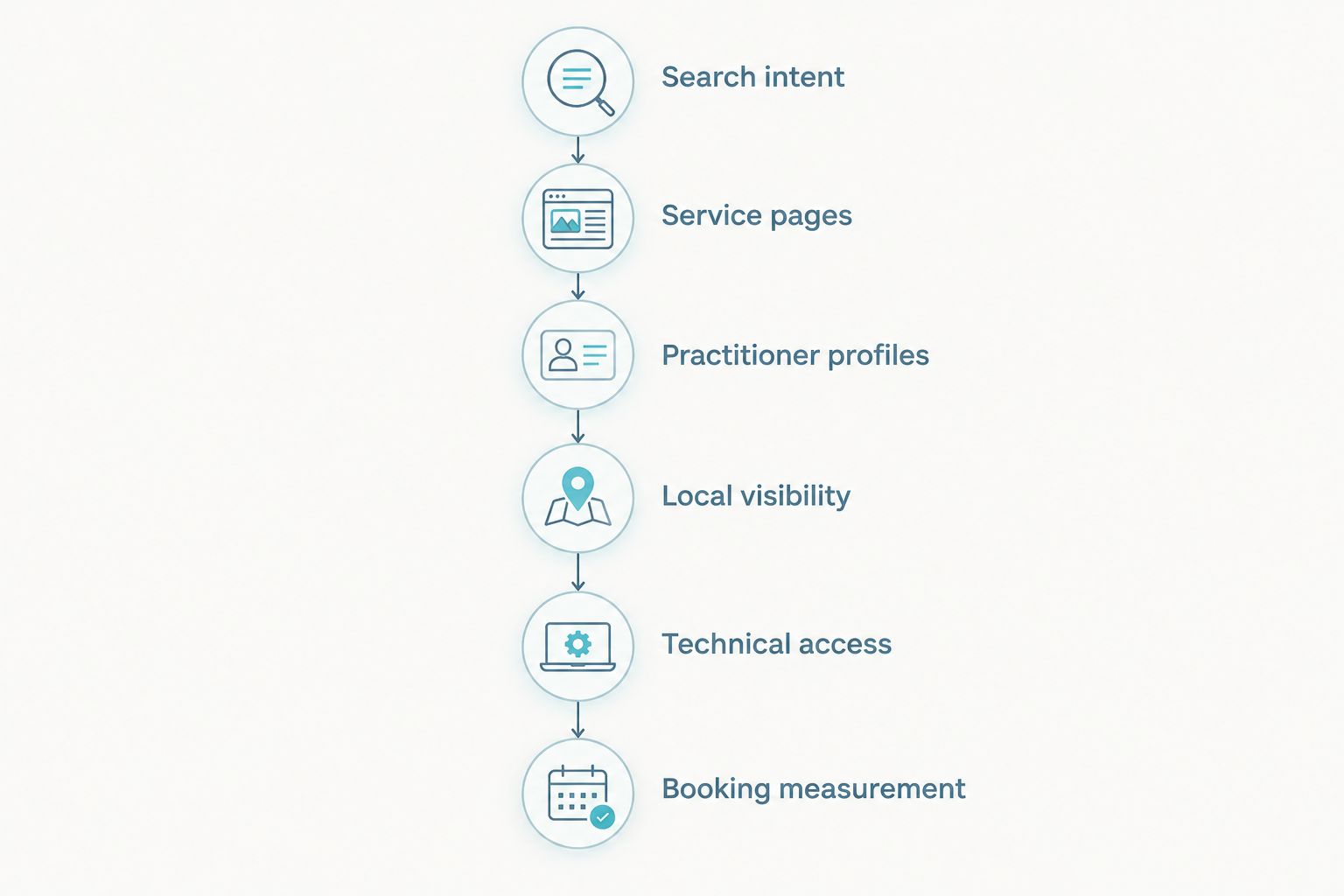
Build your no-blog SEO plan around these 6 steps:
- Search intent: Match each genuine service to the questions patients ask before booking.
- Service pages: Explain the service, who provides it and what an appointment involves.
- Practitioner profiles: Publish accurate qualifications, areas of practice and professional details.
- Local visibility: Maintain accurate location information and an eligible Google Business Profile.
- Technical access: Check that search engines can discover and index important pages.
- Booking measurement: Track relevant enquiries and appointment requests, not just visits.
Start with Google Business Profile management for medical practices if your immediate problem is inaccurate hours, contact details or location information.
Why this matters
A patient searching for a practitioner in a particular suburb needs a different answer from someone researching a symptom. Your website should recognise that distinction.
For your 2026 plan, prioritise pages that help patients identify the right service and contact the practice. A publishing calendar cannot compensate for an unclear service description, an outdated address or a booking form that fails on mobile.
The right question is not whether you need a blog. It is whether your existing pages answer the searches that matter to your practice.
Service-first SEO versus a blog-led approach
A service-first approach concentrates on appointment-related information. A blog-led approach adds educational coverage around related questions; neither removes the need for a usable website.
| Approach | Best for | Main advantage | Main limitation |
|---|---|---|---|
| Service-first SEO | Practices with incomplete service, practitioner or location pages | Makes core practice information easier to find and understand | Leaves some broader educational questions unanswered |
| Service pages plus selected guides | Practices with recurring patient questions that need detailed explanations | Supports both service discovery and patient education | Requires clinical review and ongoing maintenance |
| Blog-led publishing | Practices with sound core pages and a defined educational purpose | Provides space for detailed informational topics | Becomes a distraction when articles replace essential page improvements |
Start service-first when your core pages are weak. Add guides when you can name the patient question, identify the appropriate clinician to review the answer and explain how the guide supports your services.
What to prioritise in 2026 without a blog
Service pages: explain the appointment, not just the keyword
Create a distinct page where a service has a distinct purpose and enough useful information to justify it. Avoid splitting closely related services into thin pages just to target variations of the same phrase.
A strong service page explains:
- What the service covers and its limits.
- Which practitioner or team provides it.
- What patients should expect before and during an appointment.
- Whether your practice requires a referral or preparation, where applicable.
- Where the service takes place and how to request an appointment.
Use the service name naturally in the page title, main heading and relevant copy. Add the location where it helps patients understand where care is provided—not to repeat suburb names throughout the page.
Do not turn a service page into a diagnosis tool. Have a suitable clinician review clinical statements and distinguish general information from individual medical advice.
Practitioner profiles: make professional details easy to verify
Give patients clear information about the people providing care. Include accurate names, qualifications, professional roles and areas of practice that the practitioner has approved.
Connect practitioner profiles to the relevant service pages. That relationship helps visitors move from understanding a service to identifying who provides it.
The advantage is clarity and accountability. The maintenance requirement is keeping profiles accurate when practitioners, credentials or consulting arrangements change.
Location pages: describe real places
If your practice operates from multiple genuine locations, give each location useful, specific information. Include its address, contact details, opening hours, relevant services and practical access information where confirmed.
Do not create a page for every suburb surrounding the practice by changing the place name in otherwise identical text. A page should help someone use that location, not merely imply a presence there.
For a single-location practice, a clear location or contact page can carry this information. You do not need a large location-page library to explain where patients should go.
Local visibility: keep your practice information consistent
Maintain an eligible Google Business Profile with accurate categories, hours, contact details and a relevant website destination. Correct conflicting information in directories and other listings you control.
Google describes local ranking in terms of relevance, distance and prominence. Accurate information helps Google understand your practice, but profile edits cannot change how far your consulting rooms are from the searcher.
Treat public responses carefully. Do not confirm that someone is a patient or reveal details of treatment when replying to a review.
How to organise the work without a publishing calendar
Use the same sequence as your no-blog SEO plan: search intent, service pages, practitioner profiles, local visibility, technical access and booking measurement. Finish each stage with a practical check before moving on.
For example, do not mark a service page complete merely because its copy is approved. Confirm that patients can reach it from the navigation, identify the practitioner and find the correct appointment route.
Keep a simple change log showing what changed, when it changed and which patient need it addresses. This gives your team a useful record without turning the work into a content-production exercise.
Technical SEO: check access before adding content
Search engines need access to your important pages before those pages can compete in search. A technically accessible site is a foundation, not a ranking guarantee.
Use these 4 checks before commissioning more copy:
- Indexing: Confirm that important pages are not accidentally blocked or marked noindex.
- Navigation: Make services, practitioners and locations reachable through ordinary website links.
- Mobile booking: Test telephone links, forms and appointment routes on a phone.
- Page integrity: Correct broken links, unnecessary redirects and conflicting duplicate pages.
Google Search Console helps you inspect indexing and see which searches bring impressions and clicks. Use those observations to improve existing pages before assuming that every visibility problem needs a new article.
Structured data can describe relevant facts in a machine-readable format. It must match visible information, and adding it does not guarantee a special search appearance.
Why medical SEO results vary
Not having a blog is only one aspect of your website strategy. The work required also depends on the practice itself and the searches it wants to serve.
- Service scope: A practice offering distinct services needs enough information to explain each one accurately.
- Location structure: Multiple consulting locations require clear details about what happens at each address.
- Existing website condition: Indexing problems or broken booking routes need attention before additional publishing.
- Patient questions: Some questions fit within service-page FAQs; others require a separate educational guide.
- Clinical review: Medical information needs a responsible reviewer and a process for keeping it current.
- Search competition: Review the pages appearing for your relevant searches to identify information your website does not yet provide.
Choose work that fixes an identifiable gap. Publishing because another practice publishes is not a sufficient brief.
When should a medical practice add educational articles?
Add educational articles when a patient question needs a fuller answer than your service page can reasonably provide. Give each article a purpose beyond attracting a visit.
Useful subjects include appointment preparation, explanations of a diagnostic process and distinctions between services your practice genuinely provides. Confirm the details with the relevant clinician rather than copying another practice's instructions.
Keep brief booking questions on the service page. If patients only need to know what documents to bring, that answer should not require a separate article and another search.
For 2026, build your topic list from actual reception queries and relevant Search Console searches. A small, clinically reviewed resource library is a valid alternative to a recurring blog schedule.
Do you need new content every week to rank?
No weekly publishing schedule is required for a medical practice to rank. Search visibility depends on more than how frequently you publish, and new posts do not repair inaccurate or inaccessible core pages.
Update information when services, practitioners, appointment processes or clinical guidance change. Review older material for accuracy instead of changing dates to make unchanged advice look new.
Assign an owner to important pages. Someone should be responsible for confirming that the information still reflects how the practice operates.
Can an agency manage medical SEO without writing blog posts?
Yes, an agency can manage medical SEO through service-page improvements, technical work, local visibility and measurement. Make those deliverables explicit in the brief rather than accepting an article quota as the whole strategy.
ReachDigital is a fit for medical practices seeking agency-managed SEO rather than a standalone writing service. ReachDigital offers SEO alongside other digital marketing services; the practice must still supply accurate operational information and approve clinical statements.
Ask for a prioritised scope tied to your website's actual gaps. An agency relationship does not remove the practice's responsibility for medical accuracy or patient confidentiality.
How to measure a no-blog SEO plan in 2026
Measure whether relevant searches lead people to useful pages and then to meaningful contact. Separate practice-name searches from non-brand searches so you can distinguish existing recognition from broader service discovery.
Review these 3 measurement groups:
- Discovery: Relevant search queries, impressions and clicks to service and location pages.
- Action: Calls, form submissions and appointment requests from organic website visits.
- Outcome: Whether enquiries concern services you provide and become confirmed appointments.
A telephone-link click is not the same as a completed call. A booking-form submission is not the same as an attended appointment.
Keep those distinctions visible in reporting. Avoid sending patient names, symptoms, diagnoses or other sensitive details into general marketing analytics tools.
FAQ
Can a medical practice do SEO without a blog?
Yes, a medical practice can do SEO without a blog by improving service pages, practitioner profiles, location information, local visibility and technical access. It still needs useful, accurate website content.
What's the best place to start with SEO for my medical practice?
Start with the pages patients need to understand your services and request an appointment. Check indexing, service descriptions, practitioner details, location information and mobile booking before adding articles.
Is a Google Business Profile enough for medical SEO?
A Google Business Profile supports local visibility but does not replace detailed website pages. Use your website to explain services, practitioners and appointment processes beyond the profile's summary information.
Do doctors need to publish blog posts every week?
Doctors do not need to publish blog posts every week for SEO. Update important pages when facts change and publish educational material when it answers a genuine patient question.
Can I put patient questions on my service pages instead of a blog?
Yes, service-page FAQs are suitable for concise questions about that service. Use a separate, clinically reviewed guide when an answer needs substantial explanation.
Can ReachDigital help with SEO if my practice does not want a blog?
ReachDigital offers SEO services to businesses, including medical practices. Request a scope focused on your service pages, technical website condition, local visibility and measurement rather than assuming a recurring blog schedule is necessary.
Will improving my practice website guarantee more appointments?
Improving your practice website does not guarantee more appointments. Track relevant search visibility, enquiries and confirmed bookings separately to assess what the work achieves.
One last thing
Before approving your next article, ask reception which website question patients still phone to clarify. Check whether the answer is missing, unclear or buried on your existing pages.
Make your next 2026 improvement an answer patients can find before they call. Sometimes the most useful content work is a clearer paragraph on a service page—not another blog post.