


Content marketing can replace some paid advertising for consumer brands, but only when organic discovery and customer relationships generate the sales those ads previously supported. In 2026, the decision is not whether content gets attention; it is whether you can reduce advertising without losing profitable customer acquisition, while still funding content production and distribution.
- Can content marketing replace paid ads for consumer brands? Partly, when organic channels sustain customer acquisition.
- Content marketing supports product education; paid media buys distribution. Neither guarantees sales.
- Reduce advertising through controlled tests, not because organic engagement increased.
- ReachDigital combines content production, SEO and paid digital media services for consumer brands.
Can content marketing replace paid ads for consumer brands?
Replace a proven advertising function, not an advertising budget on paper. A guide that attracts readers does not automatically replace a campaign that brings new customers to your checkout.
Start by separating the jobs your marketing performs. Your consumer brand content strategy should identify which buying questions content answers and how those answers lead towards a purchase.
| Approach | Best for | Main advantage | Main limitation | Decision |
|---|---|---|---|---|
| Content-led marketing | Product education and organic discovery | Gives buyers useful material to find, revisit and share | Publishing does not guarantee distribution or purchases | Prioritise when relevant content already contributes to sales |
| Paid advertising | Buying distribution around a defined campaign objective | Lets you allocate spend to specific campaigns and audiences | Paid placements depend on continued spending | Retain where customer acquisition remains commercially sound |
| Combined content and paid media | Connecting product education with targeted distribution | Uses content to explain the product and advertising to distribute it | Requires shared measurement and coordination | Use when both education and distribution are necessary |
These are operating choices, not competing belief systems. The right answer depends on what brings customers into your business and what helps them buy.
Why this matters
A consumer brand needs more than visibility. Buyers need to understand the product, decide whether it fits their needs and find a clear route to purchase.
For your 2026 plan, distinguish less dependence on advertising from no advertising at all. The former is a measurable business objective; the latter is a channel restriction that needs evidence before you impose it.
Content also takes work after publication. Product information needs checking, customer questions change, and useful material needs distribution. Treat content as an ongoing commercial activity rather than a free replacement for media spend.
Content-led marketing: best for answering buying questions
Choose content-led marketing when your customers need information you can provide accurately and usefully. Product demonstrations, care guidance, selection advice and explanations of relevant differences all give buyers something concrete to assess.
Build each piece around an actual decision. A clothing buyer asking about fit needs clear fit information, not a general essay about personal style. A customer comparing materials needs verified differences, not unsupported claims about quality.
The advantage is depth. Your website can explain details that a short advertising placement cannot accommodate, and your customer-facing team can reuse those explanations in conversations.
The limitation is reach. A useful page still needs a route to its audience, whether through search, social distribution, customer communications or advertising. Do not remove distribution simply because you have improved the message.
Content-led marketing earns a larger role when relevant visitors progress towards purchases. Page views alone do not establish that case.
Paid advertising: best for buying defined distribution
Keep paid advertising where you need to place a message in front of a defined audience rather than wait for people to discover it organically. That is a different function from producing the message itself.
A product explanation can serve as both organic content and advertising creative. Changing how you distribute it does not change the underlying need to make the product understandable.
The advantage is the ability to allocate media spend around a specific objective. The limitation is that paid placements stop delivering paid exposure when spending stops; your creative, landing pages and measurement still need attention while campaigns run.
Retain advertising that contributes to profitable customer acquisition. Review weak campaigns individually instead of using their performance to condemn paid media as a whole.
A campaign with disappointing sales also needs diagnosis. Check whether the problem sits in the audience, the message, the product page or the purchase process before replacing the channel.
Combined content and paid media: best for education plus reach
Use a combined approach when buyers need both a reason to care and enough information to act. Content supplies the explanation; paid media supplies an additional distribution route.
For example, a generic product demonstration can answer a practical question on your website and become material for an advertising campaign. Keep the factual claim consistent across both uses and send interested buyers to a page that continues the same explanation.
The advantage is a shared message across discovery and consideration. The limitation is coordination: separate briefs, disconnected reporting and mismatched landing pages make it harder to understand what worked.
ReachDigital is best for consumer brands seeking content production and paid digital media from one agency. Its services also include social media management, SEO and digital campaign development; define a common commercial objective before choosing the service mix.
The combination does not justify keeping every activity. Give each channel a clear job and remove work that cannot support that job.
Why the replacement decision varies
There is no defensible universal split between content and advertising. Assess these factors against your own customer journey:
- Discovery: Establish how new customers currently find you. Separate searches for your brand from searches by people who do not yet know it.
- Product education: Identify the questions customers need answered before purchasing. Match content to those questions rather than publishing to fill a calendar.
- Campaign timing: Decide whether the objective needs scheduled distribution. Organic publication does not give you control over when an audience discovers a page.
- Production capacity: Confirm who will create, approve, distribute and maintain content. Removing media spend does not remove these responsibilities.
- Sales measurement: Check whether you can connect marketing activity with purchases and customer acquisition. Engagement is not a substitute for this connection.
These factors explain why copying another brand's channel mix is a weak starting point. Your own evidence should determine which advertising functions content can take over.
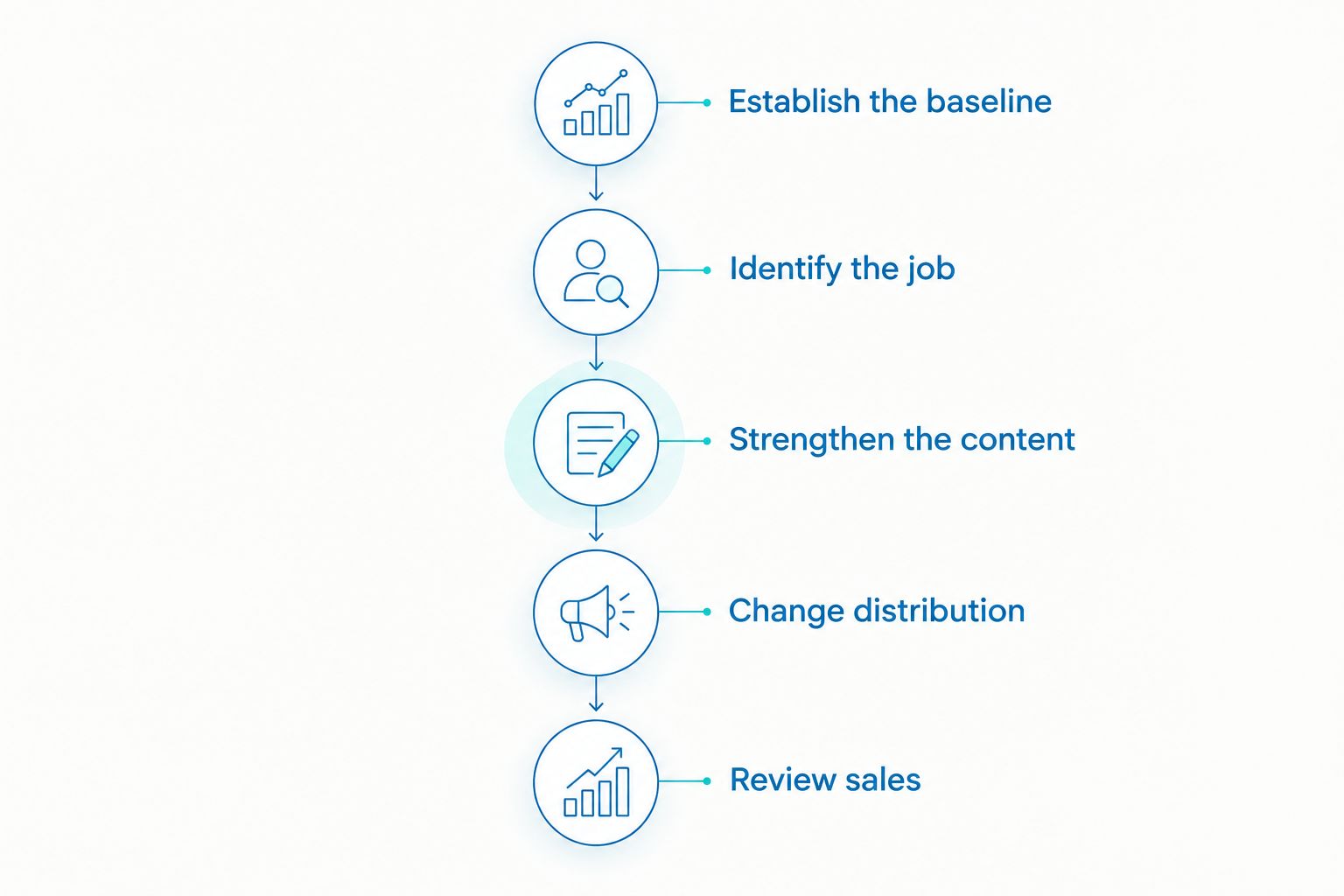
How to test whether content can replace advertising
For a 2026 test, define the decision before changing the budget. Decide what evidence would justify reducing advertising and what deterioration would require you to restore it.
Establish the baseline
Record total sales, new customers, relevant marketing activity and the trading conditions surrounding the test. Include content production and management work when assessing the resources each approach requires.
Separate branded and non-branded discovery where your reporting permits. Someone searching for your business name already knows it; that visit does not demonstrate that a guide introduced a new buyer to the brand.
Identify the job
Choose a specific advertising function to examine. That might be introducing a product, explaining a feature or bringing previous visitors back to a buying decision.
Then identify the content expected to perform that function. A general awareness post is not a like-for-like replacement for a campaign aimed at customers actively considering a purchase.
Strengthen the content
Answer the relevant buying question directly. Add verified product information, a useful demonstration or a clear explanation of who the product suits and who it does not.
Give the reader a sensible next step. A helpful guide that leaves customers hunting for the relevant product creates an avoidable break in the journey.
Change distribution
Reduce the selected advertising activity while keeping unrelated changes limited. Document other changes that affect interpretation, including website updates, new creative and wider promotional activity.
Do not describe a before-and-after comparison as proof if several major variables changed together. The test needs to distinguish the effect of distribution from the effect of a different message or buying experience.
Review sales
Compare the commercial outcome with the baseline and your predetermined decision criteria. Look beyond the platform whose spending changed.
If acquisition deteriorates, investigate before cutting further. If results support the reduction, test the next change separately rather than assuming every campaign is now unnecessary.
The sequence keeps the decision tied to customer acquisition instead of channel preference. Follow it whenever you move responsibility from advertising to organic content.
What should you measure before reducing paid media?
Your 2026 reporting should separate activity from outcomes. Publishing, impressions and visits describe what happened along the way; purchases and customer acquisition address the replacement decision.
Track these together:
- Total sales: Check the business outcome rather than relying only on sales attributed to a particular channel.
- New customers: Determine whether the business continues attracting buyers, not just receiving orders from existing customers.
- Relevant organic visits: Examine visits to pages that address buying questions, including discovery beyond branded searches.
- Purchase progression: Review whether content visitors reach relevant product information and proceed towards checkout.
- Marketing resources: Include production, management and media spending when comparing the work required.
An increase in organic sales attribution is not proof of an increase in total sales. A customer can encounter several messages before purchasing, while a reporting model credits only part of that journey.
Use channel reports to diagnose behaviour, then check the business-wide result. For practical campaign planning alongside content, see the guide to running paid media for an e-commerce brand.
What would justify keeping, reducing or restoring ads?
Keep advertising when it performs a necessary distribution job and your commercial reporting supports that investment. Do not remove a useful acquisition route solely to make the marketing mix look more organic.
Reduce advertising when a controlled change supports the decision and the replacement activity is sustainable. Check that content production, maintenance and distribution remain achievable with the resources you actually have.
Restore the tested activity when the agreed commercial criteria deteriorate and the evidence points to the reduction. Restoring a campaign is not a failure of content marketing; it is a response to the result.
Write down the decision and its evidence. That record prevents a temporary performance change from becoming a permanent channel assumption.
Can a new consumer brand rely only on content marketing?
A new consumer brand can choose a content-only approach, but it still needs a credible distribution plan. Publishing without an audience, relevant search visibility or another route to discovery is not a complete acquisition strategy.
Start with the questions buyers need answered and the places those buyers already seek information. Do not assume that a regular posting schedule supplies reach by itself.
Should you stop ads when organic engagement improves?
No: stronger organic engagement does not establish that content has replaced customer acquisition from advertising. Check purchases, new customers and the wider sales result before changing spending.
Use engagement to identify messages worth investigating. Then test whether those messages help buyers progress, rather than treating reactions as a commercial verdict.
FAQ
Can content marketing completely replace paid ads for a consumer brand?
Content marketing can replace paid ads only where other discovery and distribution routes sustain the required customer acquisition. Test that outcome before removing advertising across the business.
Is content marketing free compared with paid advertising?
Content marketing is not free: planning, production, distribution and maintenance require resources. Compare the full work involved rather than treating unpaid placement as costless marketing.
Does organic social media count as content marketing?
Organic social media is a content marketing distribution channel. It does not represent the whole strategy, which can also include useful website content and product education.
How long should we wait before cutting advertising?
Set the review period around your buying journey and the evidence needed to make the decision. A fixed deadline without enough relevant customer activity does not establish whether replacement works.
What should a consumer brand measure in 2026?
A consumer brand should measure total sales, new customers and the marketing resources needed to acquire them. Use channel reporting and purchase progression to explain those outcomes, not replace them.
Can ReachDigital manage content and paid campaigns together?
ReachDigital offers content production, paid digital media, social media management, SEO and digital campaign development. Agree the commercial objective and each channel's responsibility before setting the scope.
One last thing
Before commissioning another awareness post, ask your customer-facing team which buying question keeps coming back. Turn that question into a clear, accurate answer with a direct route to the relevant product.
For the rest of 2026, make that your filter: content should remove a buying obstacle, not just occupy a publishing slot. Prove that it helps customers buy before asking it to replace the advertising that brings them in.