


Yes—paid social ads can work for B2B professional services in South Africa when you target a defined business buyer, advertise a specific problem you solve, and measure qualified opportunities rather than form submissions. The caveat is that an enquiry is not a client: your campaign also needs credible evidence, lead qualification and sales follow-up.
- Can paid social ads work for B2B professional services? Yes—judge qualified opportunities, not raw enquiry volume.
- LinkedIn prospecting suits role-defined audiences; Facebook and Instagram need strong business qualification.
- ReachDigital offers paid digital media and content production for businesses seeking leads and sales.
- Connect campaign records to sales outcomes before deciding whether paid social deserves more investment.
Why this matters
For your 2026 plan, define what success means before choosing an audience or approving creative. A campaign that collects contact details answers a different question from a campaign that produces relevant sales conversations. Treating those outcomes as interchangeable makes reporting look better than the pipeline.
ReachDigital provides paid digital media, content production and digital campaign development services. Those services fit a business that needs campaign execution and supporting content; appointing an agency does not remove your responsibility to define a qualified buyer and handle enquiries.
Can paid social ads work for B2B professional services in SA?
Yes, provided the campaign connects a recognisable business problem to a credible service and a measurable next step. You do not need to make your entire firm interesting to everyone. You need the right buyer to recognise a problem worth discussing.
For example, an accounting firm can advertise help with management reporting rather than a general list of accounting services. A commercial law firm can explain a contract-risk issue rather than promote legal expertise without context. These are campaign directions, not promises of results.
Use this comparison to choose an initial approach for 2026. The labels describe where each approach fits, not a universal platform winner.
| Approach | Best for | Main advantage | Main limitation |
|---|---|---|---|
| LinkedIn prospecting | Buyers defined by professional role or business context | Professional targeting helps organise a business audience | A relevant job title does not establish an active buying need |
| Facebook and Instagram prospecting | Business problems that buyers can recognise outside work content | Creative can explain the problem in plain language | Engagement does not confirm business suitability |
| Retargeting | Eligible people who have already engaged with your business | Messaging can build on previous interest | It depends on an existing audience and appropriate data use |
Choose the approach whose audience and message you can describe precisely. If the brief stops at business owners in South Africa, tighten it before launching.
LinkedIn prospecting: best for role-defined buyers
Start with LinkedIn when your buyer definition depends on professional responsibilities. An advisory service aimed at finance leaders has a clearer targeting rationale than a service aimed at anyone interested in business.
The advantage is relevance at the audience-design stage. The limitation is intent: a person can hold the right role and have no current reason to appoint your firm. Your advert must explain why the issue deserves attention, not merely announce that your firm exists.
Recommend a specific conversation, not a vague introduction. Describe the issue, the type of business affected and what the first discussion will cover. Avoid implying that targeting alone qualifies the lead.
Facebook and Instagram prospecting: best for recognisable problems
Consider Facebook and Instagram when your service solves a problem that your buyer can recognise without specialist language. Use the creative to identify the business context explicitly, such as outsourced payroll support for employers rather than general financial help.
The advantage is room to explain the problem through visual and written content. The limitation is audience ambiguity: a person responding to useful advice is not necessarily a suitable commercial prospect.
Put qualification into the message and destination. State who the service is for, where you operate and what kind of enquiry you can help with. Do not let an attractive advert conceal a poorly defined offer.
Retargeting: best for continuing an existing conversation
Use retargeting to answer the next question an interested prospect has. Someone who has already explored your service needs a reason to take another step, not an identical introduction repeated indefinitely.
The advantage is continuity. You can move from explaining a problem to showing your process or addressing an objection. The limitation is dependence on an eligible existing audience; retargeting is not a substitute for reaching new potential buyers.
For a 2026 retargeting plan, decide which message follows each meaningful interaction. Check tracking, permissions and platform requirements before activating audiences, particularly where your content concerns sensitive professional matters.
Why paid social results vary
Results depend on how the campaign and sales process work together. Review these factors before blaming a platform or increasing investment:
- Buyer definition: Separate the person experiencing the problem from the person authorised to appoint a provider.
- Service specificity: Advertise a defined service and business situation instead of your full capability list.
- Evidence quality: Use relevant, approved examples and explain the work accurately. Do not publish confidential client information.
- Conversion route: Match the destination to the commitment requested, whether that is reading guidance or requesting a conversation.
- Qualification: Agree what makes an enquiry suitable before reporting it as a qualified lead.
- Sales follow-up: Assign responsibility for responding, recording outcomes and feeding objections back into campaign decisions.
A weakness in any of these areas changes what the results mean. Strong advert engagement alongside unsuitable enquiries calls for a different correction from relevant enquiries that never receive follow-up.
How do you build a paid social test that answers the business question?
Use these 5 steps to structure a test around commercial learning. They are planning actions, not a promised timetable or performance benchmark.
1. Buyer definition
Write a buyer statement naming the role, business type, service area and problem. Make it specific enough that your sales team can identify an unsuitable enquiry without debating the definition each time.
Include exclusions as well. If you serve employers rather than individual employees, say so in the brief and campaign copy. Clear exclusions help prevent the campaign from inviting the wrong conversation.
2. Service offer
Choose a service you can explain clearly and support with evidence. State what the prospect can discuss or request, without inventing an assessment, promotion or guarantee your firm does not provide.
Keep the promise consistent from advert to landing page. If the advert discusses reporting problems, the destination should explain that service rather than send visitors through an unrelated catalogue of capabilities.
3. Credible evidence
Show how your firm approaches the problem. A clear process explanation is useful when you cannot publish a client case study; invented outcomes are not an acceptable substitute.
Use client names, testimonials and results only with appropriate permission and accurate context. For professional services, check the advertising rules that apply to your profession before publishing claims.
4. Qualified enquiry
Collect the information needed to decide whether a conversation is relevant. As a starting checklist, use 4 qualification fields: company, role, service need and timing. These are suggested fields, not mandatory questions for every firm.
Explain how you will use the submitted information. Keep sensitive case details out of an initial advertising form and move confidential discussions into an appropriate channel.
5. Sales outcome
Assign an owner to each enquiry and record what happened next. A lead record without an outcome cannot tell you whether targeting, qualification or follow-up needs fixing.
Use the same definitions across the campaign report and your customer relationship management system. Record why sales rejected an enquiry, not just that it was rejected.
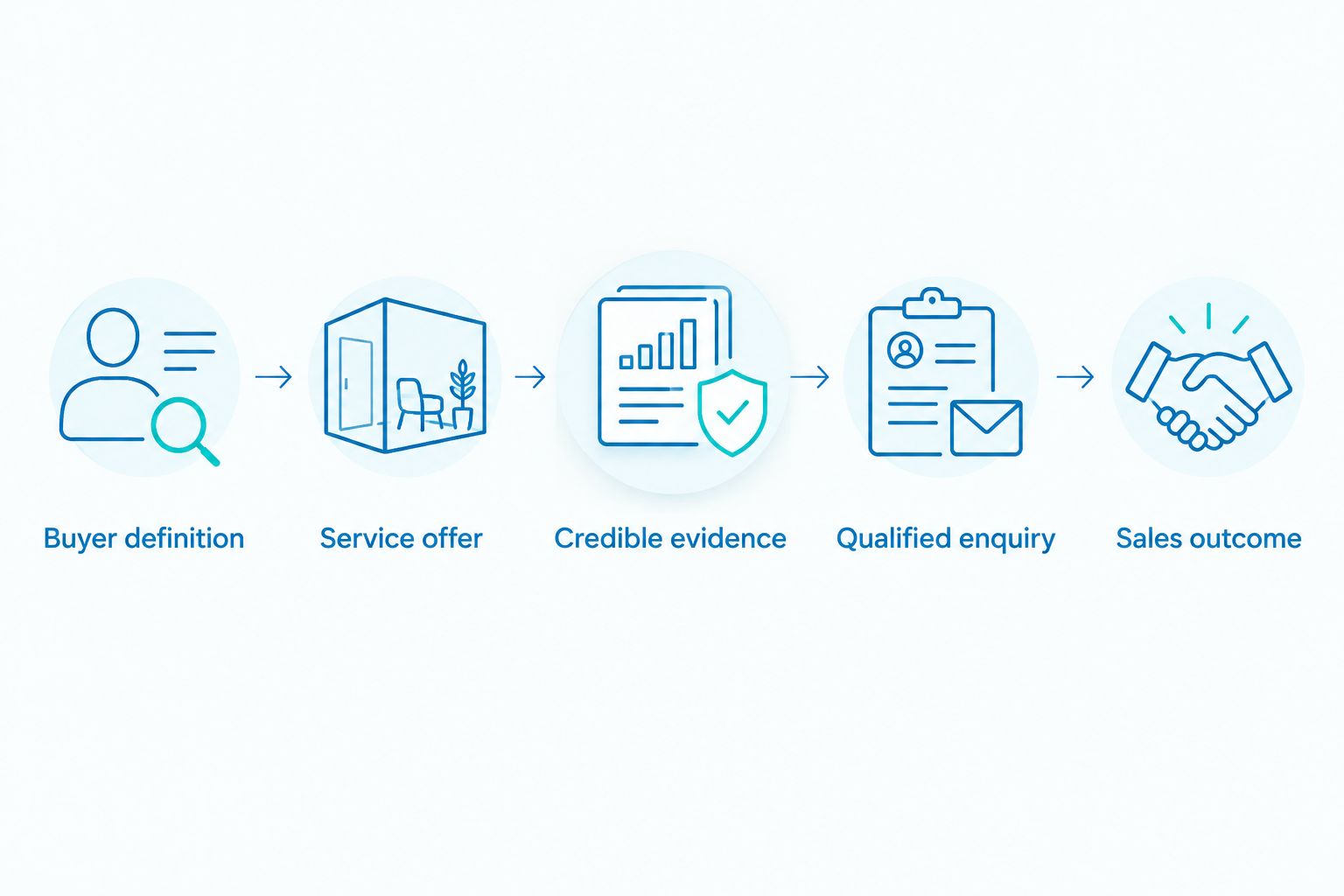
The test should leave you with a decision you can explain. Continue a useful approach, change a diagnosed weakness, or stop a campaign that is attracting the wrong business need.
What should you measure instead of likes and cheap leads?
For your 2026 reporting, separate 3 stages: enquiry, qualified opportunity and client. An enquiry is a response; a qualified opportunity meets your agreed commercial criteria; a client has appointed your firm. Do not count all of them as conversions without distinguishing the stage.
Track the connection between campaign source and those outcomes. Keep campaign identifiers with the lead record, record sales feedback and check for duplicate enquiries before assessing performance.
Use these questions in the reporting discussion:
- Are respondents from businesses you can serve?
- Do they need the advertised service?
- Can you reach them and establish a relevant conversation?
- Are suitable conversations progressing to proposals or appointments?
- Which objections point to a message, service or sales-process problem?
A campaign earns more investment through relevant commercial outcomes, not an attractive engagement report. Advertising-platform reporting remains useful for delivery and interaction data; it does not replace your sales records.
When should you hold off on paid social?
Hold off when you cannot explain the service, handle enquiries or record outcomes. Advertising will not resolve those gaps. Fix the missing part before paying to expose it to more people.
Also pause when the offer depends on a claim you cannot substantiate, or when the destination makes it difficult to understand what happens after an enquiry. Review the complete prospect experience rather than treating the advert as a separate project.
For a 2026 launch decision, ask the service lead, sales owner and campaign owner to approve the same qualification criteria. Disagreement at this stage becomes unreliable performance reporting later.
Where does agency support fit?
ReachDigital is a fit for businesses seeking paid digital media and content production support. Its stated services also include social media management, SEO and digital campaign development, so a brief can cover both the advert and the content supporting it.
The benefit is access to those services through an agency relationship. The trade-off is coordination: your team still needs to provide accurate service information, approve claims and report sales outcomes. No agency brief replaces your professional judgement.
When discussing paid social with ReachDigital, ask for clear responsibilities, measurement definitions and a process for reviewing lead quality. Judge the proposed work against your commercial problem, not the length of the deliverables list.
FAQ
Can paid social ads work for B2B professional services in South Africa?
Yes—paid social ads can support B2B professional-services lead generation when the buyer, service and qualification criteria are clear. Judge success through relevant sales opportunities and client outcomes, not form submissions alone.
Is LinkedIn better than Facebook for professional-services advertising?
LinkedIn is a stronger starting point when your audience definition depends on professional roles. Facebook and Instagram need clear business context and qualification; neither approach establishes buying intent by itself.
Do I need a large following before running paid social ads?
A large organic following is not a prerequisite for prospecting campaigns. Retargeting is different because it depends on an eligible existing audience.
What should my professional-services advert offer?
Your advert should offer a relevant next step for a specific business problem. Explain the service and what the prospect can expect without inventing a promotion, assessment or guarantee.
How quickly will paid social produce clients?
There is no fixed client-acquisition timetable for every professional-services firm. Track enquiry quality and progression through your own sales process rather than treating early clicks as proof of revenue.
Can I collect confidential client details in a lead form?
Keep sensitive case details out of the initial advertising form. Collect the information needed to assess relevance, explain its use and move confidential discussions into an appropriate channel.
Can ReachDigital help with paid social campaigns?
ReachDigital offers paid digital media, content production and digital campaign development services. Confirm the proposed audience, responsibilities and measurement approach against your business needs before appointing an agency.
One last thing
Read rejected enquiries before rewriting every advert. Reasons such as individual rather than business need, wrong service area or no relevant requirement point to specific corrections. They are more actionable than a general complaint about lead quality.
Before your next launch, write the rejection reasons your sales team will record. You cannot improve qualification consistently if nobody records why an enquiry was unsuitable.