


A digital marketing campaign in South Africa is ready to launch when the brief, account access, creative, destination page and measurement have passed approval—not after a fixed number of days. For your 2026 plan, separate production time from platform review and post-launch optimisation; a campaign going live does not mean it has proved its results.
- How long does it take to launch a digital marketing campaign? Readiness, approvals and scope determine the date.
- ReachDigital’s launch checklist is best for teams coordinating creative, paid media and website work.
- Separate campaign preparation, platform review and performance evaluation in your launch plan.
- Reduce scope before you remove tracking tests or final approvals.
How long does it take to launch a digital marketing campaign in SA?
Set the launch date against completed dependencies, not a generic turnaround promise. A campaign using approved assets and a working destination page has a different preparation workload from a campaign requiring photography, website development and stakeholder sign-off.
Start with a written brief. The questions in how to brief a digital campaign agency in South Africa help turn a preferred launch date into a defined scope.
Use this sequence to establish the schedule:
- Confirm the brief. Agree on the audience, offer, objective, channels and success measure.
- Check access. Confirm that the people building and measuring the campaign have the permissions they need.
- Prepare the destination. Finish the page, form, booking route or checkout that receives campaign traffic.
- Produce and approve assets. Finalise copy, imagery, video and channel-specific versions.
- Test the journey. Verify links, submissions, measurement and enquiry delivery before release.
- Approve and submit. Record business sign-off and submit advertising for any required platform review.
Some tasks can run together. Others cannot: finalising an advert before agreeing on its offer creates avoidable rework.
Why this matters
A launch date is a coordination decision, not just a media-buying decision. Your creative team can finish its work while the website remains unfinished, or your ads can be approved while enquiries arrive in an unattended inbox.
For a 2026 campaign, define what everyone means by launched. Assets delivered, ads submitted, ads serving and enquiries reaching your team are different milestones. Put those distinctions in the project plan before anyone announces a date.
ReachDigital’s digital marketing launch checklist treats readiness as a customer journey: someone sees the message, reaches the destination, takes an action and receives the expected response. A break anywhere in that chain deserves attention before release.
Which launch approach fits your campaign?
Choose the approach that matches your objective and existing assets. The table compares preparation requirements, not promised delivery times.
| Launch approach | Best for | Preparation advantage | Main limitation |
|---|---|---|---|
| Existing-asset launch | A defined offer with approved creative and a working page | Reuses completed production work | Existing assets still need suitability and tracking checks |
| New-creative launch | A message requiring original photography, video or design | Builds assets around the current brief | Production and approval must finish before those assets run |
| Website-dependent launch | A campaign needing a new landing page, form or checkout changes | Aligns the destination with the campaign | Development and testing become launch dependencies |
| Phased launch | A campaign with a self-contained, approved starting scope | Releases ready work without waiting for every later asset | Requires clear boundaries and consistent messaging |
Do not select an approach solely because it sounds faster. Reusing creative is sensible when it communicates the right offer. It is not sensible when the message, audience or destination has changed.
Existing-asset launch: validate before reusing
An existing-asset launch suits a campaign whose core materials are already approved. Check that the message still matches the offer, the destination remains correct and the intended audience can take the promised action.
The advantage is fewer production tasks. The drawback is inherited problems: old copy, unsuitable image crops or a broken form can survive unnoticed when everyone assumes the material is ready.
New-creative launch: schedule the approval path
A new-creative launch suits a campaign that needs original material to explain its message. Agree on the concept before producing the finished assets, then identify who approves factual claims and who approves presentation.
The advantage is a closer fit between the brief and the content. The drawback is dependency: changes to the concept can affect filming, editing, design and copy together.
Website-dependent launch: include the destination in scope
A website-dependent launch suits a campaign whose intended action needs a new or changed customer journey. Treat page content, form behaviour and measurement as campaign work, rather than unrelated technical tasks.
The advantage is control over the experience after the click. The drawback is that an approved advert cannot compensate for an unfinished destination.
Why campaign launch timing varies
The useful question is not whether a campaign is simple or complicated. Ask which unfinished tasks prevent release and who controls their completion.
- Brief stability: Changes to the audience, objective or offer affect work already in production. Agree on these before approving detailed execution.
- Account permissions: Building ads, publishing pages and checking analytics require appropriate access. Confirm permissions through a working login, not an invitation alone.
- Production scope: Original filming, photography and design introduce preparation and review tasks that reusing approved material does not.
- Destination readiness: A campaign requiring development has dependencies beyond copy and creative. Include form delivery and mobile checks in acceptance criteria.
- Approval ownership: Unclear responsibility leaves completed work waiting. Name the person authorised to resolve conflicting feedback.
- Platform review: Submission and approval are separate events. Treat review as an external dependency rather than a release guarantee.
These factors give you a practical basis for a schedule. Ask for task owners, dependencies and completion criteria instead of accepting an unexplained date.
How do you build a launch schedule you can actually use?
Work backwards from the business event, then check whether the dependencies support that date. If the campaign supports an opening, product introduction or property release, identify which parts of that event are genuinely fixed.
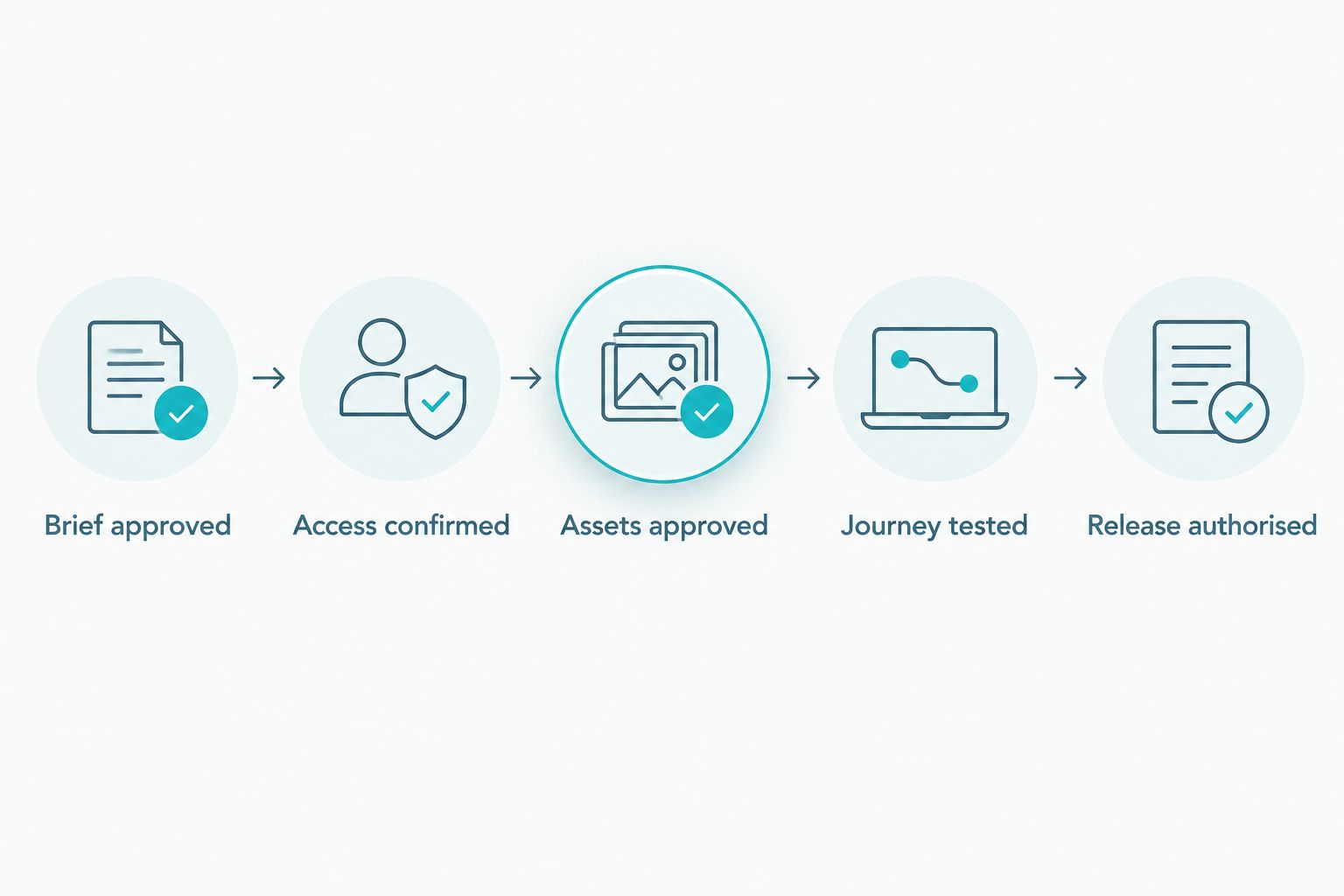
For your 2026 launch plan, use the same readiness gates across everyone’s work. A gate is a decision that a defined piece of work is ready—not a meeting booked in a calendar.
Brief approved
Write down the audience, desired action, message and destination. Specify what the campaign must not claim, especially when factual or professional review is needed.
The approval should settle the direction. If stakeholders still disagree about what is being promoted, production is not ready to proceed.
Access confirmed
List the accounts and systems required for execution. Assign an owner to resolve permission issues and confirm that access works before dependent tasks begin.
Keep account ownership clear. Grant the permissions needed for the job rather than treating password sharing as a substitute for proper access.
Assets approved
Review the actual versions intended for publication. Copy approved in a document is not the same as copy checked inside the final design or advert preview.
Check the message, destination and intended action together. Each asset should make sense to someone who has not attended the briefing meetings.
Journey tested
Follow the route your customer will take. Open the destination on a phone, complete the intended action and confirm where the submission or transaction appears.
Check measurement separately from the visible experience. A page can look correct while the action you need to evaluate is not being recorded correctly.
Release authorised
Record who has approved release and which assets that approval covers. Separate internal authorisation from any platform decision still outstanding.
Confirm who monitors the campaign after publication. A handover without an owner leaves problems waiting for someone to notice them.
Can you launch sooner without cutting essential checks?
Reduce the initial scope before reducing quality control. Choose a clear audience, an approved message and a working destination. Leave unfinished extensions out of the initial release rather than sending traffic into an incomplete experience.
A phased launch works when its opening scope stands on its own. For example, an approved enquiry campaign does not need to wait for unrelated content, provided the advert, enquiry route and follow-up process are ready.
This distinction matters when discussing paid social campaign launch timelines: creative readiness, account access and platform review belong in the release plan, while performance evaluation belongs after delivery begins. Combining them into a single deadline makes the schedule harder to manage.
Keep a written boundary around each phase. State what is included, what is deferred and which later changes require new approval. Otherwise, a phased launch becomes an unfinished campaign with a different name.
The trade-off is coordination. You gain flexibility by releasing ready work, but you must keep messages and destinations consistent as later assets join the campaign.
What should South African teams check before release?
Use local context where it affects the customer’s experience, not as a reason to invent a separate national turnaround benchmark. A South African audience does not remove the need to check production, access, approvals and measurement.
For a 2026 launch, confirm these practical details:
- Geography: Match the campaign’s targeting and copy to the areas the business actually serves.
- Language: Check that the advert and destination communicate the same offer clearly to the intended audience.
- Scheduling: Confirm the intended time zone and whether the receiving team is available when enquiries arrive.
- Claims: Obtain the appropriate review for statements about products, property or medical services before publication.
- Personal information: Check collection, access and follow-up arrangements against applicable privacy requirements, including POPIA.
- Handover: Confirm who receives enquiries and how the business handles them after submission.
These are release checks, not promises of a particular approval period. Where legal or professional interpretation is required, obtain qualified advice rather than treating a marketing checklist as clearance.
Is launching a campaign the same as getting results?
Launching and getting results are different milestones. Publication confirms that the campaign has entered delivery; it does not establish whether the campaign is producing commercially useful outcomes.
Decide what evidence will support evaluation before launch. An enquiry campaign needs visibility into submitted enquiries and their quality, while an e-commerce campaign needs a working view of the purchase journey.
The distinction is central to how long it takes to see results from Google Ads. Keep the release schedule separate from the evaluation plan so neither becomes an unsupported promise.
For your 2026 reporting, distinguish delivery, recorded actions and business outcomes. An advert serving correctly is an operational milestone; a suitable enquiry or completed sale answers a different question.
What should you ask before accepting a launch date?
Ask what must be true for the proposed date to hold. A useful answer identifies dependencies, client responsibilities and the process for handling changes.
ReachDigital’s digital marketing launch checklist gives you a straightforward acceptance rule: approve the date together with the scope, owners and release criteria. A date without those details is not a usable project plan.
Ask the team:
- Which assets and destination pages are included?
- Which permissions or materials must the business supply?
- Who has final approval authority?
- What happens if the offer changes after approval?
- Which checks must pass before release?
- Who handles launch monitoring and enquiry follow-up?
Keep unresolved items visible. A named blocker with an owner is easier to manage than a general assurance that everything is on track.
FAQ
How long does it take to launch a digital marketing campaign in South Africa?
The launch date depends on completion of the brief, access, creative, destination, testing and approvals. Agree on a schedule against those dependencies rather than a universal turnaround promise.
Can I launch a campaign using content I already have?
You can use existing content when it matches the approved message, audience and destination. Check the final formats, factual claims and customer journey before publication.
Can ads go live before a new website is finished?
Ads can use an existing destination if that destination supports the campaign’s intended action and passes testing. Hold any campaign that depends on unfinished website functionality.
Does platform approval mean my campaign is ready?
Platform approval does not replace business approval or customer-journey testing. Confirm the destination, measurement and enquiry handling before treating the campaign as ready.
What should I send before campaign preparation starts?
Send the objective, audience, offer, available assets, destination details and approval contacts. Confirm the account access required for building, publishing and measurement.
Is a phased campaign launch better than waiting?
A phased launch fits work with a complete, independently usable starting scope. Waiting is the better choice when unfinished work prevents the intended customer action.
Will campaign launch immediately prove a return?
Campaign launch does not prove a return. Define the business outcome and verify measurement before using campaign activity to judge performance.
One last thing
Your final rehearsal should include the person receiving the enquiry—not just the person publishing the advert. Submit a test, confirm it arrives in the right place and ask the receiving team to explain the next action.
If the handover fails, the campaign is not ready, even when the creative is approved. Fix that connection before release.