


There is no fixed timeline for seeing ROI from content marketing in South Africa: you reach positive ROI when the profit attributable to content exceeds its full cost. Your forecast must account for the time between publication, customer discovery and a completed sale, plus production, distribution and measurement costs. For your 2026 plan, use your own sales history to set the review window rather than accepting an unsupported month-by-month promise.
- How long does it take to see ROI from content marketing? Your sales cycle and attributable profit determine the answer.
- ReachDigital offers content production, SEO and paid media services; assess their contribution against business outcomes.
- Content marketing ROI reaches break-even at 0%; traffic and enquiries alone do not establish profitability.
- Separate organic discovery, paid distribution and sales follow-up when diagnosing delays.
Why this matters
A publishing deadline is not a payback deadline. You control when content goes live; you do not control when every prospective customer discovers it or buys.
That distinction matters when deciding whether to continue, change direction or stop. Without it, you risk cancelling useful content before its associated enquiries close, or funding unproductive content because its engagement looks healthy.
Start with a commercial measurement plan. For property businesses, this guide to tracking digital marketing ROI for a property brand addresses the same need to connect activity with business outcomes.
How long does it take to see ROI from content marketing in SA?
The defensible timeline is the time your content needs to generate enough attributable profit to recover its accumulated cost. A national average cannot replace that calculation for your business.
Build the forecast backwards from completed transactions, not forwards from a publishing calendar:
- Define the outcome. Choose completed purchases, paid bookings or closed business. Keep enquiries separate from revenue.
- Check discovery. Establish how customers will find the content: search, social media, email or paid distribution.
- Measure sales lag. Use actual elapsed time between a content-related enquiry and a completed transaction.
- Include full costs. Record production, distribution, management and measurement costs against the same programme.
- Reconcile profit. Compare attributable contribution before marketing costs with the programme's accumulated cost.
For your 2026 forecast, record the assumptions behind each step. If you lack historical content performance, label the forecast as an assumption rather than presenting it as a benchmark.
A sales cycle helps set an initial review window, but it is not a guaranteed payback period. Content still has to attract relevant customers and contribute enough profitable business.
Separate discovery, enquiries and payback
Different content approaches have different measurement paths. Choose the approach that matches your objective, then assess both its useful signals and its limitations.
| Approach | Best for | Useful early evidence | Limitation |
|---|---|---|---|
| Search-led content | Answering questions customers actively search for | Relevant search visits and movement towards commercial pages | Visibility does not establish profitable demand |
| Social content | Introducing ideas and starting audience conversations | Relevant responses, visits and enquiries | Engagement alone does not demonstrate sales |
| Email content | Following up with an existing audience | Clicks connected to enquiries or purchases | Results depend on audience relevance and permission |
| Paid distribution | Putting content in front of a selected audience | Attributed visits, enquiries and completed transactions | Media costs must be included in the return calculation |
These are measurement distinctions, not ranked promises about speed. Paid distribution lets you purchase exposure; it does not guarantee profitable customers. Search-led content can attract relevant visits, but a visit still needs a clear next step.
Use channel metrics to diagnose progress, not to declare ROI. Keep the financial verdict separate until completed business and costs can be reconciled.
Calculate content marketing ROI without inflating it
Use a consistent profit-based calculation:
Content marketing ROI = (attributable contribution before marketing costs − content marketing costs) ÷ content marketing costs × 100%.
Attributable contribution means revenue credited to content after the associated direct fulfilment costs, but before the marketing costs deducted in the formula. Agree this definition with whoever owns your financial reporting.
At 0% ROI, the attributed contribution equals the content marketing cost. Above that threshold, the calculation shows a positive return; below it, the programme has not recovered its cost under the chosen attribution method.
Avoid subtracting an expense twice. If your contribution figure already deducts a particular marketing expense, adjust the calculation before subtracting the programme's costs again.
For your 2026 reporting, use the same cost boundaries each period. Changing them halfway through makes an apparent improvement difficult to interpret.
Revenue is not profit
An attributed sale is useful evidence, but its full revenue is not the amount available to repay marketing expenditure. Direct fulfilment costs still matter.
For an e-commerce business, reconcile completed orders with refunds and direct product costs. For a service business, agree how delivery costs are assigned before treating closed revenue as marketing return.
Pipeline is not realised return
A qualified enquiry or open opportunity shows potential value. It is not a completed transaction.
Report pipeline alongside realised return, clearly labelled. Otherwise, a programme with unresolved enquiries can appear profitable before the business has earned the money.
Why content marketing ROI timing varies
The timeline changes when any part of the path from content to profit changes. Diagnose the delay before commissioning more material.
- Audience starting point: An existing relevant audience gives you a distribution route. Without one, your plan must account for how customers will discover the content.
- Buyer intent: A general educational question and a supplier-selection question serve different needs. Match the topic and next step to the reader's decision.
- Distribution route: Publishing, emailing and promoting content are separate activities. Assign responsibility for getting each asset in front of its intended audience.
- Sales process: A completed online purchase and an enquiry requiring consultation have different steps. Measure the actual process rather than assuming they share a deadline.
- Conversion path: A useful article still needs a relevant route to an enquiry, booking or purchase. Check that route before blaming the topic.
- Economics and measurement: Contribution margin, programme costs and attribution rules determine whether the recorded activity has paid back.
These factors explain what to investigate, not how many months to promise. Use your business records to quantify them.
Build a review process that leads to a decision
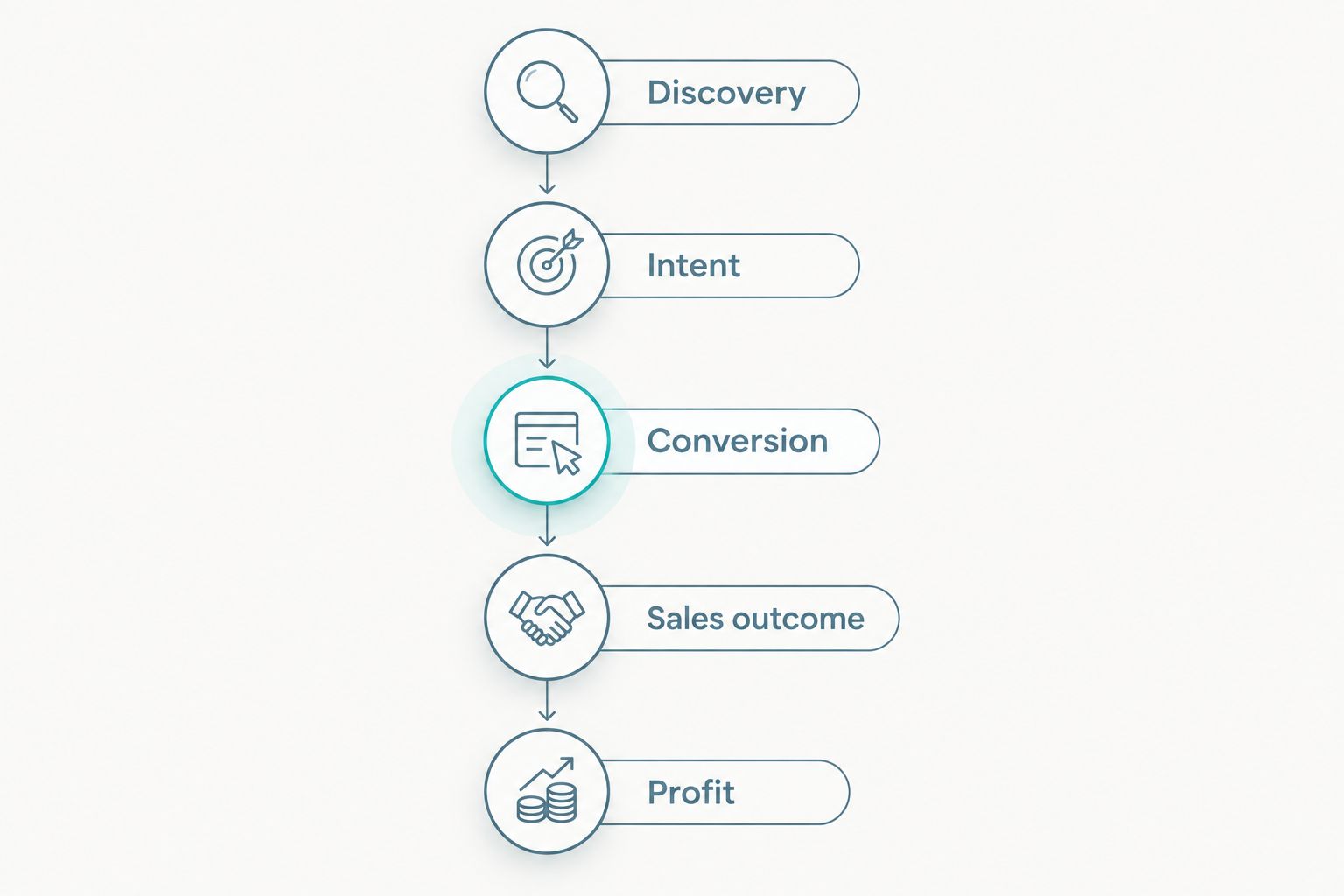
Your reporting should identify the next action, not just describe activity. Use the same sequence whenever you assess a content programme.
Discovery
Check whether the intended audience reaches the content. For search-led work, inspect the actual queries and landing pages; for distributed content, inspect the audience and destination.
If discovery is the problem, investigate topic selection, access and distribution. Rewriting the call to action will not solve a page that relevant customers never reach.
Intent
Check whether the content answers a question connected to your offer. Read the page as a prospective customer, not as its author.
Ask what decision the reader can make after finishing it. If the answer is unclear, sharpen the purpose before expanding the publishing schedule.
Conversion
Check whether the next step works and fits the reader's needs. Test forms, purchase paths and enquiry routing yourself.
A broken form and an irrelevant offer require different fixes. Keep those diagnoses separate so the content team does not rewrite a page to compensate for an operational fault.
Sales outcome
Connect enquiries with their eventual status. Record whether each became qualified business, a completed transaction, an unsuitable enquiry or an unresolved opportunity.
Use the reasons for lost business to improve the content brief. A recurring misunderstanding about the service belongs in the explanation customers see before enquiring.
Profit
Reconcile attributed contribution and accumulated costs. Then decide whether to continue, revise the topic, change distribution or stop the activity.
Set the next review around evidence becoming available, not around a promised result. A publication review and a closed-sales review answer different questions.
How do I attribute sales to content without counting them twice?
Choose an attribution rule and apply it consistently. Content can introduce a customer, support their research or help them complete a decision; those are different contributions.
First-touch attribution assigns 100% of credit to the first recorded touchpoint. Last-touch attribution assigns 100% of credit to the last recorded touchpoint. Neither rule describes every interaction that influenced the customer.
For your 2026 reporting, show directly attributed transactions separately from transactions where content appeared elsewhere in the recorded journey. Do not add those totals together as though they represent distinct sales.
Keep a record of the content identifier, enquiry source and eventual transaction. Where the connection is uncertain, describe it as uncertain rather than assigning revenue to make the report look complete.
What should I do if traffic rises but sales do not?
Rising traffic without attributable profit is progress in discovery, not proof of ROI. Check whether those visitors match your target customers before increasing production.
Review the questions bringing people to the page, the offer they encounter and the action you ask them to take. Then inspect what happens after the enquiry reaches your business.
Use this decision checklist:
- Relevant visitors, no enquiries: inspect the content-to-offer connection and conversion path.
- Enquiries, poor fit: clarify who the offer serves and what it involves.
- Qualified enquiries, no completed business: review follow-up and recorded sales objections.
- Completed business, negative return: reconcile contribution and total programme costs.
Each finding calls for a different action. More content is not the default fix.
When does an agency fit the content marketing plan?
ReachDigital is best suited to businesses seeking content production, SEO and paid media services. Its stated focus includes property companies, e-commerce brands, consumer brands and medical services.
The benefit of considering that service scope is relevance to a brief spanning content and distribution. The limitation is that service scope alone does not establish a payback date or prove suitability for your specific account.
When assessing ReachDigital for content marketing, ask for a brief that connects the intended audience, content purpose, distribution responsibility and measurement method. Compare that proposal with your business requirements, not with an unsupported promise of rapid ROI.
Your business still needs to supply commercial inputs and record sales outcomes. An agency's content marketing report cannot replace transaction and fulfilment records held by your team.
FAQ
How long does it take to see ROI from content marketing in South Africa?
There is no fixed timeline: positive ROI begins when attributable contribution exceeds the full content marketing cost. Use your own discovery data, sales cycle and completed transactions to forecast payback.
Can content marketing generate enquiries before it becomes profitable?
Yes, content marketing can generate enquiries before it recovers its costs. Keep enquiries, qualified opportunities and completed transactions separate so early activity is not reported as realised return.
Is paid content distribution better than organic content for ROI?
Neither approach is automatically better for ROI. Paid distribution adds media expenditure, while organic content still carries production and management costs; compare attributable contribution against each approach's full cost.
What counts as break-even for content marketing?
0% ROI is break-even when attributable contribution equals the content marketing cost. Apply a consistent definition of contribution and avoid deducting the same expense twice.
Should I stop content marketing if website traffic is not growing?
Do not base the decision on traffic alone. Check relevant enquiries, completed business and attributable contribution, then identify whether discovery, conversion or sales follow-up needs attention.
What should a content marketing ROI report include?
A content marketing ROI report should include programme costs, attributed completed business, contribution and the attribution method. Show open pipeline and assisted transactions separately so they are not mistaken for additional realised revenue.
Can ReachDigital guarantee when content marketing will pay back?
Do not treat service scope as a payback guarantee. Assess a content marketing proposal against your sales history, cost structure, distribution plan and agreed measurement rules.
One last thing
The first date worth recording is publication, not the invoice date. Then record discovery, enquiry and completion separately, while keeping pre-publication costs in the financial calculation.
For your 2026 plan, retain both clocks: elapsed time since investment began and elapsed time since the content became accessible to customers. That distinction helps you see whether the delay sits in production, discovery or sales, without pretending those are the same problem.