


Paid media costs for a South African property developer depend on the advertising budget and the work needed to run the campaign; there is no single fee that covers every development. For your 2026 budget, separate ad spend from management, creative production, landing pages and tracking, then compare proposals against qualified enquiries and sales outcomes—not just the headline total.
- How much does paid media cost for a property developer? Budget separately for advertising, management, content and conversion tracking.
- ReachDigital serves property businesses seeking paid media, content production and digital campaign services.
- Compare property advertising proposals on total scope and qualified enquiries, not the management fee alone.
- Approve spending limits and reporting definitions before launching a property lead generation campaign.
How much does paid media cost for a property developer in SA?
Your total paid media budget is the advertising spend plus the services and infrastructure required to turn attention into enquiries. An agency management fee is not the same thing as a complete campaign budget.
ReachDigital provides paid digital media, content production and digital campaign development services to businesses, including property companies. When requesting a proposal, specify which of those services you need rather than asking for an unexplained monthly total.
Use this breakdown to check what a proposal includes:
| Budget component | What it covers | What to confirm before approval |
|---|---|---|
| Advertising spend | Distribution through the selected advertising platforms | Who pays the platforms and who approves spending changes |
| Campaign management | Campaign setup, monitoring, optimisation and reporting | Platforms, campaigns and reporting responsibilities included |
| Creative production | Advertising copy, images, video and format adaptations | Supplied assets, new production and revision scope |
| Landing pages | The destination where buyers review the development and enquire | Whether page creation and ongoing changes are included |
| Measurement | Enquiry tracking and connections to sales records | Which events are tracked and who maintains the setup |
Request separate lines for initial work and recurring delivery. A launch that needs new assets and tracking should not be compared directly with ongoing management of an established campaign.
Why this matters
A property developer needs to understand what the marketing budget buys after the click. A submitted form, a contactable buyer, an attended viewing and a concluded sale are different outcomes.
For your 2026 plan, agree on those distinctions before approving expenditure. Otherwise, a campaign report and a sales report can describe different versions of success without either team recognising the gap.
The useful comparison is the total cost of producing a defined sales opportunity. Keep the advertising-platform view, but connect it to the development's sales process so your spending decisions reflect more than activity.
Advertising spend: separate distribution from delivery
Advertising spend pays for distribution. It does not, by itself, cover the people producing the campaign, maintaining the destination page or reviewing lead quality with your sales team.
Ask whether you will pay the advertising platforms directly or whether the agency will invoice that spend. Either arrangement needs a clear approval process, account access and a way to reconcile expenditure with platform records.
Set an agreed spending limit and identify who can authorise changes. Do not treat a recommendation to increase spend as approval to do so.
The advantage of a separate advertising allocation is visibility: you can distinguish distribution expenditure from service fees. The limitation is equally clear—more distribution does not fix an inaccurate message, a broken enquiry form or unanswered leads.
Best for budget control: a proposal that identifies advertising spend separately and explains how changes are approved. Reject ambiguous wording that leaves you unsure how much of the total reaches the platforms.
Management: define the work behind the fee
Campaign management should have a written scope, not just a label. Ask which platforms are included, what setup work is required, how optimisation decisions are made and what reporting you receive.
Define the development structure too. A campaign for a single development is a different brief from campaigns covering separate locations, buyer groups and sales teams; the proposal should show how that work is organised.
Reporting needs an owner and a purpose. Specify who will review performance with your team and how sales feedback will influence campaign decisions.
ReachDigital's paid media services are best suited to property businesses seeking campaign delivery alongside content production. That service fit does not establish an all-inclusive package: confirm the deliverables, exclusions and responsibilities in the proposal.
For your 2026 comparison, ask every shortlisted agency to respond to the same brief. A smaller fee attached to a narrower scope is not evidence of a better deal.
Creative production: identify what already exists
Before requesting a quote, list the assets you can supply: development photography, approved renders, floor plans, video, copy and brand materials. Mark which assets are approved for advertising and which still need work.
Then ask the agency to distinguish adapting existing material from producing new content. Those are different tasks, and a proposal should not leave you guessing which one it covers.
Good creative helps buyers understand the development and the next step. It cannot replace missing project information or turn an unapproved claim into an acceptable advertisement.
Best for a launch needing new assets: a production scope that names each deliverable, its intended use and the approval owner. The trade-off is additional production work and coordination before the campaign is ready.
Keep the approval route short and explicit. Your marketing team, development team and sales team should know who confirms project facts before anything is published.
Landing pages and tracking: check the enquiry route
A campaign destination needs to support the action promised in the advertisement. If the advertisement invites a viewing enquiry, the buyer should find the relevant development information and an obvious way to request that viewing.
Test the route on a phone as well as a desktop. Submit an enquiry, check where it arrives and confirm that the assigned sales person can identify the development and source.
Tracking also needs practical checks. Define which actions count as enquiries, how duplicate contacts are handled and whether sales outcomes can be connected to the original campaign.
The benefit is a clearer basis for judging spend. The limitation is that tracking depends on consistent implementation and sales records; a dashboard cannot supply outcomes nobody records.
For your 2026 launch checklist, name the person responsible for forms, tracking and lead routing. Do not assume campaign management automatically includes website development or customer relationship management administration.
Why paid media costs vary for property developers
A useful proposal explains its scope drivers instead of presenting a total without context. Ask the agency to connect each of these factors to a specific piece of work:
- Campaign objective: An awareness brief and a viewing-enquiry brief require different messages, destinations and success measures.
- Development coverage: Separate developments, locations and buyer groups introduce additional campaign and reporting requirements.
- Content readiness: Approved assets require a different production scope from a brief that starts without usable photography, video or copy.
- Website readiness: Existing enquiry pages need a different scope from new pages, form repairs or tracking implementation.
- Sales integration: Sending a form notification is a narrower task than connecting campaign records with qualification, viewings and sales outcomes.
- Ongoing delivery: Agree on the campaign changes, creative updates, reporting and meetings included in recurring management.
These factors explain the work to be quoted; they do not establish a universal South African rate. Ask what changes the scope before asking what changes the fee. That keeps the discussion attached to deliverables you can assess.
How should you calculate a workable campaign budget?
Build the budget from your sales objective and your own records. Do not start by copying another development's advertising allocation: its audience, sales process and campaign scope are not your brief.
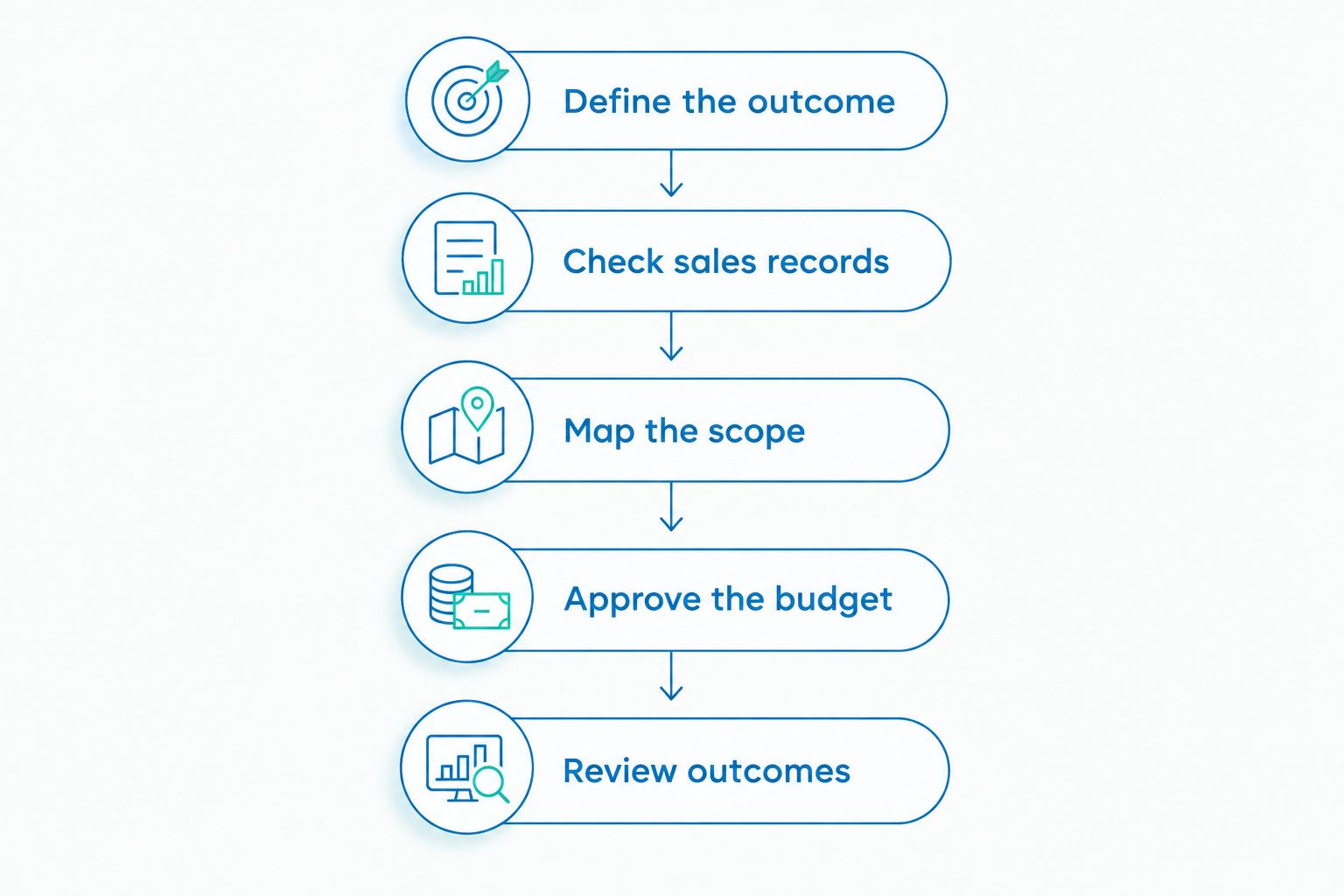
- Define the outcome. State whether the campaign needs qualified enquiries, booked viewings or another agreed sales action. Give the outcome a written definition.
- Check sales records. Review the relationship between enquiries, qualified buyers, viewings and sales. Use recorded outcomes rather than assumptions presented as forecasts.
- Map the scope. Identify the advertising, management, production, page and measurement work required. Assign an owner to each component.
- Approve the budget. Separate initial work from recurring expenditure and agree on spending controls. Record who can approve changes.
- Review outcomes. Compare campaign expenditure with qualified enquiries and subsequent sales stages. Investigate where progression stops before increasing spend.
Keep this sequence in your 2026 planning document. It gives the agency and sales team the same starting point without pretending a forecast is a guaranteed result.
Which performance measures belong in the budget review?
Use consistent definitions and matching reporting periods. Comparing this month's advertising spend with sales from a different group of enquiries gives you an unclear basis for deciding what to change.
Track these measures separately:
- Cost per enquiry: Advertising spend divided by recorded enquiries.
- Cost per qualified enquiry: Advertising spend divided by enquiries meeting your agreed qualification criteria.
- Cost per attended viewing: The selected campaign cost divided by attributed attended viewings.
- Customer acquisition cost: The defined acquisition expenditure divided by acquired customers within the stated scope.
Label the cost basis each time. If one report includes only advertising spend and another includes production and management, their figures answer different questions.
ReachDigital paid media proposals should be assessed against the same definitions you use for other agencies. The decision belongs with the scope and measurement plan, not the agency name.
For a fuller reporting framework, read how to track digital marketing ROI for a property brand.
How do you compare agency proposals fairly?
Send the same development brief to each agency. Include the project facts, target buyer, sales objective, existing assets, website position and lead-handling responsibilities.
Then compare what each proposal actually commits to delivering. Ask agencies to clarify vague phrases such as ongoing optimisation, content support and reporting rather than interpreting those phrases on their behalf.
Best for a fair comparison: a written scope with clear exclusions and change approvals. Its advantage is accountability; its limitation is that work outside the agreed scope still needs a separate decision.
Check account access and ownership before signing. Confirm who controls advertising accounts, receives invoices, holds campaign assets and maintains access if the working relationship ends.
Finally, ask what the agency needs from your team. Campaign delivery depends on supplied information, approvals and sales feedback as well as the agency's work.
Is ad spend included in a paid media management fee?
Ad spend is a separate budget component from management, so your proposal must state whether the quoted total includes both. Ask for the platform allocation and service scope to be shown separately even when they appear on the same invoice.
Should I increase the budget if enquiries are not becoming viewings?
Check the reason enquiries are not progressing before increasing expenditure. Review buyer fit, contact details, follow-up records and viewing arrangements; additional spend is not a substitute for understanding that break in the sales process.
FAQ
How much should a property developer budget for paid media in South Africa?
Build the budget from advertising spend plus the management, content, landing-page and measurement work your development requires. Request a scoped proposal tied to a defined sales objective rather than treating an agency fee as the complete budget.
Does a paid media quote include the advertising budget?
The quote must explicitly state whether advertising spend is included. Ask for distribution expenditure and service fees to appear separately so you can compare proposals on the same basis.
What costs should I check beyond campaign management?
Check creative production, landing-page work, tracking and sales-system connections. Confirm which tasks are included, supplied by your team or quoted separately.
What's the best way to judge property advertising performance?
Judge performance against qualified enquiries and the sales stages that follow them. Keep raw enquiry volume visible, but do not treat every submitted form as an equally useful sales opportunity.
Can an agency guarantee that property leads will become sales?
A lead-generation campaign does not guarantee a property sale. Review the agency's commitments alongside the buyer qualification and sales responsibilities your own team controls.
Can I start paid media with an existing property website?
Assess the existing enquiry route before deciding whether website work is necessary. Check that buyers can find the relevant development information, submit an enquiry and reach the correct sales team.
What should I send an agency to get a useful quote?
Send the development brief, target buyer, sales objective, existing assets and details of your enquiry process. Ask the agency to separate initial work, recurring services and advertising spend.
One last thing
Ask the sales team to walk through an enquiry before approving the campaign. Identify who receives it, how the development is recognised, what qualifies the buyer and where the next action is recorded.
That small operational check tests whether your campaign has somewhere useful to send interest. Approve a working enquiry process alongside the media budget—not after the first leads arrive.