


Video production in South Africa is priced around your brief: what needs filming, how the footage will be edited, and where you intend to use it. For a 2026 budget, request an itemised project quote and check whether it includes planning, filming, editing, usage permissions and delivery—not just time behind the camera.
- How much does video production cost in South Africa? Compare defined deliverables, not an unexplained project total.
- ReachDigital suits businesses seeking digital marketing and social media management around a video campaign.
- Separate production, editing, licensing and distribution when you assess a video production quote.
- Approve the script and delivery requirements before filming to limit avoidable rework.
How much does video production cost in South Africa?
The useful figure is the total for your agreed scope, not a generic national average. Ask each supplier to quote against the same brief, then compare what you receive and what remains your responsibility.
A filming-only proposal and a finished-campaign proposal are different purchases. The second can include scripting, production coordination, editing, captions and channel-specific versions that the first leaves to you.
For ReachDigital, the relevant connection is digital marketing and social media management: decide how you will distribute the video before you commission it.
| Quote component | What you should ask to see | What to clarify |
|---|---|---|
| Pre-production | Concept, script, shot list and scheduling | Who develops and approves the creative work? |
| Production | Crew, equipment, location and filming scope | What happens if filming exceeds the agreed scope? |
| Post-production | Editing, sound, colour and graphics | Which treatments and feedback rounds are included? |
| Usage | Permissions for talent, music and other assets | Which channels, territories and usage periods are covered? |
| Delivery | Finished files, captions and agreed versions | Are source footage and editable files included? |
| Distribution | Publishing, campaign setup or media management | Is this separate from making the video? |
Why this matters
A quote only becomes comparable when the deliverables match. Otherwise, you are comparing different amounts of work under the same label.
For your 2026 campaign, define what the viewer should do after watching. A product demonstration, property walkthrough and service explainer need different footage and editorial choices; treating them as interchangeable makes the brief harder to price.
Buy the footage and finished assets your campaign needs—not production complexity for its own sake. A more elaborate shoot is justified when it solves a specific communication problem.
Choose the production approach before comparing quotes
Start with the material you already have and the message you need to communicate. You do not automatically need a new shoot, but existing footage is only useful if it supports the intended story and you have permission to use it.
| Production approach | Best for | Main advantage | Main limitation |
|---|---|---|---|
| Editing existing footage | Reworking usable, permission-cleared material | Builds on assets you already hold | Cannot create missing scenes or repair every recording problem |
| New live-action filming | Showing real people, products or places | Captures evidence specific to your business | Requires coordination of people, locations and production resources |
| Animation or motion graphics | Explaining processes or abstract ideas | Shows concepts that are difficult to film directly | Changes to an approved script can require visual rework |
Editing existing footage
Best for: businesses with usable footage and a clear new purpose for it. Send the editor representative files before accepting a scope, including examples of the picture and sound quality.
Ask the editor to identify missing material before work begins. A folder full of clips does not necessarily contain a complete story, and music cannot replace a missing explanation or an unclear demonstration.
New live-action filming
Best for: businesses that need to show something real and specific. Agree on the essential scenes, speakers and locations before discussing optional shots.
The benefit is control over what gets captured. The trade-off is coordination: access, preparation and availability become part of the production plan rather than problems to solve on arrival.
Animation or motion graphics
Best for: explanations that depend on diagrams, sequences or concepts rather than physical scenes. Approve the wording and visual direction before detailed animation begins.
Animation removes the need to film every idea physically, but it still requires planning and approvals. Treat it as a production approach, not an automatic shortcut.
Why video production costs vary
The following scope decisions explain why suppliers can return different proposals for what initially sounds like the same video:
- Creative development: Supplying an approved script is different from asking a production team to develop the concept, interview questions and narrative.
- Filming requirements: Locations, scenes, speakers and specialist shots determine the work that needs to happen on set.
- People and coordination: Presenters, interviewees, performers, styling and location access introduce separate responsibilities.
- Editing complexity: Selecting interview excerpts is different from building a film around animation, detailed graphics or extensive sound work.
- Delivery requirements: Different edits, languages, captions and screen layouts need to be specified rather than assumed.
- Permissions and revisions: Usage terms and the boundary between corrections and new creative work affect what the agreement covers.
Location is part of the brief, not a sufficient explanation on its own. Ask suppliers to identify travel, accommodation or location-related requirements separately wherever they apply.
How do you get a quote you can actually compare?
Give suppliers a written brief rather than a reference video and a deadline. A reference communicates taste; a brief defines the work.
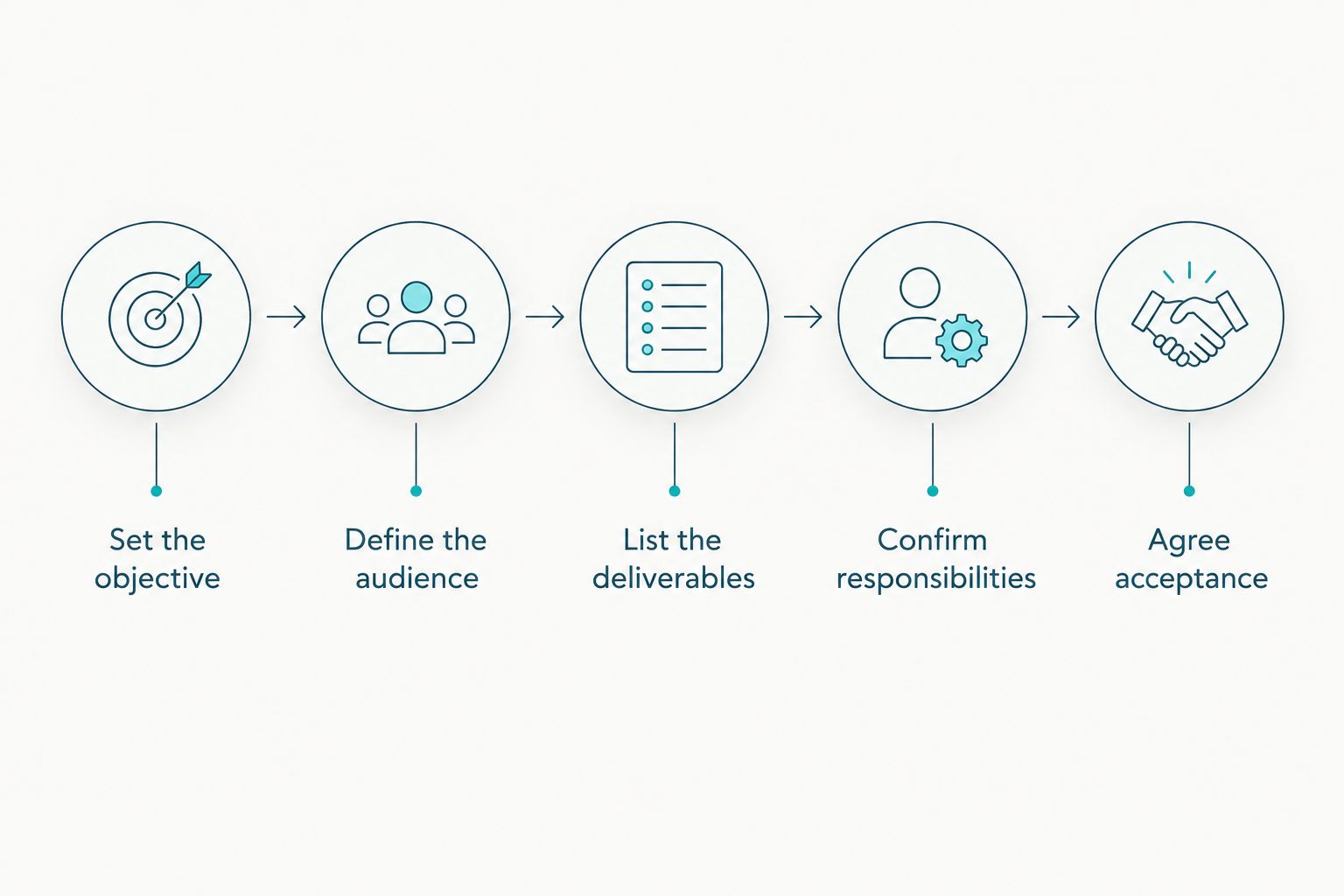
Use this sequence for your 2026 production enquiry. Keep the same requirements when you approach different suppliers, so differences in their proposals are visible.
- Set the objective. State the business action you want, such as a product enquiry, viewing request or completed purchase.
- Define the audience. Explain who is watching, what they already know and what question the video must answer.
- List the deliverables. Specify the main film, alternative openings, shorter edits, captions and required formats.
- Confirm responsibilities. Assign scripting, location preparation, participant coordination, approvals and publishing.
- Agree acceptance. Record the feedback process, delivery requirements and what counts as a change to the brief.
The brief should also identify the person who can approve the work. Conflicting feedback is an approval problem, not an editing direction.
Include examples of what you like, but explain the relevant feature: interview style, pacing, product detail or visual treatment. Your supplier should not have to guess whether you want the reference's entire production approach or just its tone.
The same discipline applies when you brief a content production agency in South Africa: make the audience, output and approval requirements explicit.
Check the work outside the filming day
Do not let a filming-day description stand in for the whole project. Preparation and finishing are separate tasks, even when a supplier combines them into a single proposal.
Before accepting the scope, ask these questions:
- Who writes the script and prepares interview questions?
- Who confirms that the location is ready and participants are available?
- Who selects the footage and builds the first edit?
- Are captions, graphics and audio finishing included?
- Who checks factual statements before the video is approved?
- What files will you receive at handover?
A bundled proposal is easier to assess when those responsibilities remain visible. An itemised proposal is only useful if the separate lines still add up to a finished, usable asset.
Ask what you must supply, not just what the supplier will deliver. Your team's preparation and approval commitments belong in the project plan.
Check usage rights before you approve the proposal
A finished video file and permission to use every element in it are separate questions. Ask the supplier to document the agreed use of music, stock material, performers and other licensed contributions.
Specify whether the video will appear on your website, organic social channels, paid advertising or elsewhere. Also clarify whether you can re-edit the material later and whether another supplier can work with the delivered assets.
The distinction matters when assessing corporate video production costs: production work, licensed contributions and permitted usage should be explicit rather than buried inside a single total.
For a 2026 agreement, record the intended channels, territories and usage period in writing. Do not assume that receiving a file settles those questions.
Ask about source footage and editable files
Request a clear handover list. Finished exports, original camera files and editable project files are different deliverables, and the agreement should say which you receive.
If you expect to update the video later, explain that before production starts. Ask how the supplier will handle licensed assets, file organisation and future changes rather than assuming unrestricted reuse.
How can you reduce the scope without weakening the video?
Protect the message first; simplify the production around it. Remove scenes that do not explain, demonstrate or support the action you want the viewer to take.
For a product film, that means prioritising the product in use and the buyer's practical questions. For a property film, it means deciding which spaces and features need to be understood rather than collecting footage without an editorial plan.
Make these decisions before filming:
- Keep locations that contribute something distinct to the story.
- Prepare products, spaces and speakers before the crew arrives.
- Approve factual statements and essential wording in advance.
- Identify shared footage that can support different planned edits.
- Consolidate feedback through an authorised decision-maker.
There are trade-offs. Reusing footage limits what you can show; reducing locations limits visual variety; removing a demonstration can leave an important question unanswered.
Choose those compromises deliberately. Cutting an essential scene from the plan is not a saving if the finished video no longer explains the offer.
Does a shorter video always require less production work?
A shorter video does not automatically require less work. Runtime describes the finished asset, not the preparation, filming or editing needed to make it.
A tightly edited advert can require multiple scenes and precise timing, while a longer interview can use a simpler setup. Compare the production requirements and deliverables rather than asking for a rate based only on finished length.
Is a filming quote the same as a video campaign quote?
A filming quote is not automatically a video campaign quote. Confirm whether the proposal covers only recording or also includes creative development, editing, publishing and campaign management.
ReachDigital's digital marketing and social media management services belong to the distribution side of that decision. Keep those responsibilities visible so you know who takes the approved video from handover to publication.
What should you measure after the video goes live?
Choose the business outcome before filming, then make sure your distribution plan can record it. A video made to generate enquiries needs a clear route from watching to taking action.
For your 2026 reporting, distinguish viewing activity from business results. Views describe consumption; enquiries, purchases and bookings describe different outcomes and should not be treated as interchangeable.
Production quality still matters, but it does not establish commercial performance on its own. ReachDigital's digital marketing remit is relevant here: the creative asset and the campaign distributing it need aligned objectives.
FAQ
How much does video production cost in South Africa?
Video production in South Africa is priced against the agreed scope, including planning, filming, editing and delivery. Request an itemised quote that also identifies usage permissions, exclusions and your responsibilities.
What should a video production quote include?
A video production quote should identify the deliverables, production responsibilities, editing scope, feedback process and handover requirements. It should also state which permissions and third-party contributions are included.
Is editing included when I book a filming day?
Editing is included only when the agreement explicitly includes it. Check whether the booking covers recording alone or also covers footage selection, sound, graphics, captions and finished exports.
Can I use existing footage instead of booking a new shoot?
You can use existing footage when its quality, content and permissions fit the new brief. Have the editor assess representative files before agreeing on the work.
Does a shorter video always mean less work?
A shorter video does not automatically mean less work. Preparation, filming complexity, animation and the required versions matter alongside finished runtime.
Will I own the raw footage after the project?
Raw footage delivery and usage rights depend on the agreement. Ask for written terms covering source files, editable projects, licensed material and future reuse.
Should advertising be included in the production quote?
Advertising should be identified separately from producing the video, whether it appears in the same proposal or a separate agreement. Confirm who handles publishing, campaign setup, media management and reporting.
One last thing
Ask the supplier to describe exactly what you will have at handover—and what you still need before publishing. That answer exposes the gap between a video that is finished in the editing suite and a campaign asset your team can actually use.
Approve the scope before you approve the spend.