


Yes—Google Ads is worth it for e-commerce brands in South Africa when the contribution from the orders it generates exceeds the full cost of acquiring them. In 2026, judge that return after product costs, fulfilment, returns and campaign management—not from reported revenue alone.
- Is Google Ads worth it for e-commerce brands? Yes, when acquired orders generate a positive contribution after acquisition costs.
- Google Ads revenue is not profit; assess product margins, fulfilment, returns and campaign management together.
- Separate branded searches from new-customer acquisition before deciding whether to expand Google Ads.
- ReachDigital suits e-commerce businesses seeking paid media, content production and SEO services together.
Why this matters
Google Ads puts your products in front of people searching for something to buy. That is valuable, but buying intent does not guarantee a profitable order: an expensive click, a weak product page or a costly return can erase the contribution.
Start with reliable purchase measurement. Your GA4-to-Google Ads conversion workflow should distinguish completed purchases from browsing activity and prevent the same purchase from becoming duplicate bidding signals.
The decision is not whether Google Ads produces sales. It is whether those sales leave your business better off.
Is Google Ads worth it for e-commerce brands in South Africa?
Google Ads is worth testing when you can measure completed orders, identify products with sufficient contribution and send buyers to a working checkout. Wait when those conditions are absent. More traffic makes existing problems more expensive; it does not fix them.
Use this decision table before approving a 2026 campaign plan.
| Decision | Best for | Advantage | Limitation |
|---|---|---|---|
| Test Google Ads | Stores with measurable purchases and understood margins | Tests whether search demand converts into viable orders | Requires spending before profitability is established |
| Expand Google Ads | Stores with verified contribution from acquired orders | Adds investment behind demonstrated performance | Additional spending does not guarantee the same return |
| Fix the store first | Stores with broken tracking or checkout friction | Addresses problems affecting every acquisition channel | Delays paid acquisition while repairs happen |
| Build demand first | Brands whose products need substantial explanation | Gives prospective buyers context before asking for a purchase | Does not replace a later acquisition test |
These decisions are not permanent labels. A store that should wait today becomes test-ready once measurement and the buying journey work. A profitable campaign also needs reassessment when product mix or fulfilment costs change.
Why Google Ads returns vary between e-commerce brands
There is no single South African return threshold that makes every store profitable. Your acceptable acquisition cost depends on the economics of the orders you receive.
- Product contribution: Revenue left after product and variable order costs determines what you can spend acquiring a sale.
- Search intent: A specific product search and a broad research query represent different buying situations.
- Checkout experience: Payment failures, unclear delivery information and difficult forms interrupt the purchase journey.
- Measurement quality: Duplicate purchase events or incorrect order values distort bidding and reporting.
- Customer mix: Returning customers and first-time buyers contribute differently to an acquisition assessment.
- Order adjustments: Cancellations and returns change the value of orders after the initial conversion appears.
Compare campaigns against your own commercial requirements in 2026. A benchmark from another retailer cannot tell you whether your product mix supports the acquisition cost.
Google Search: best for explicit buying intent
Google Search ads respond to searches through keyword targeting and related matching controls. They suit products buyers already know how to describe, especially when the landing page closely answers the query.
The advantage is the connection between what someone searches for and what you offer. The limitation is that an apparently relevant search still needs inspection: research, repair and second-hand queries are not automatically suitable for a store selling new products.
Separate searches containing your brand name from searches for the wider category. Existing customers looking for your store should not become the main evidence that paid search attracts new buyers.
Recommendation: test Google Search around a clearly defined buying need, not a loose collection of category words. Review the search terms and completed orders together before broadening coverage.
Google Shopping: best for product-led searches
Google Shopping ads use product information supplied through Google Merchant Center. They let shoppers assess a product visually before arriving at the store, making the product feed part of the advertising work rather than an administrative afterthought.
The advantage is a direct route from a product search to a relevant product page. The limitation is dependence on accurate product data and a landing page that matches what the shopper expects.
Check product titles, images, identifiers and page destinations before expanding Shopping activity. Group products by commercial suitability, not just by catalogue structure: products with different margins should not automatically share the same performance expectations.
Recommendation: test Google Shopping with products whose data and order economics you understand. Do not push the entire catalogue simply because it can be uploaded.
Performance Max: best for broader Google channel coverage
Performance Max can serve across Google's advertising channels using your conversion goals, product information and creative assets. It suits a broader campaign brief, but it is not a replacement for deciding which sales matter to your business.
Its advantage is access to several placements within a campaign. Its limitation is reduced direct control over individual placements compared with a narrowly structured Search campaign.
Give Performance Max accurate purchase values and suitable creative assets. Assess customer acquisition and product contribution separately from the campaign's headline revenue figure.
Recommendation: use Performance Max when measurement and product priorities are ready for broader coverage. Do not introduce it as a repair for unreliable tracking.
| Campaign option | Best for | Main strength | Main constraint |
|---|---|---|---|
| Google Search | Explicit product or category searches | Connects search intent with tailored ad copy | Requires search-term and landing-page discipline |
| Google Shopping | Visually identifiable products | Connects product information with shopping searches | Depends on accurate feed data |
| Performance Max | Coverage across Google's channels | Combines product and creative inputs across placements | Offers less direct placement control than Search |
How do you decide what an acquired order is worth?
Start with the order, not the advertising dashboard. Calculate net sales consistently, account for applicable tax treatment and deduct product costs plus the variable costs of completing that order.
That leaves contribution before acquisition. Deduct attributable advertising and campaign costs to assess whether the order contributes towards overhead and profit.
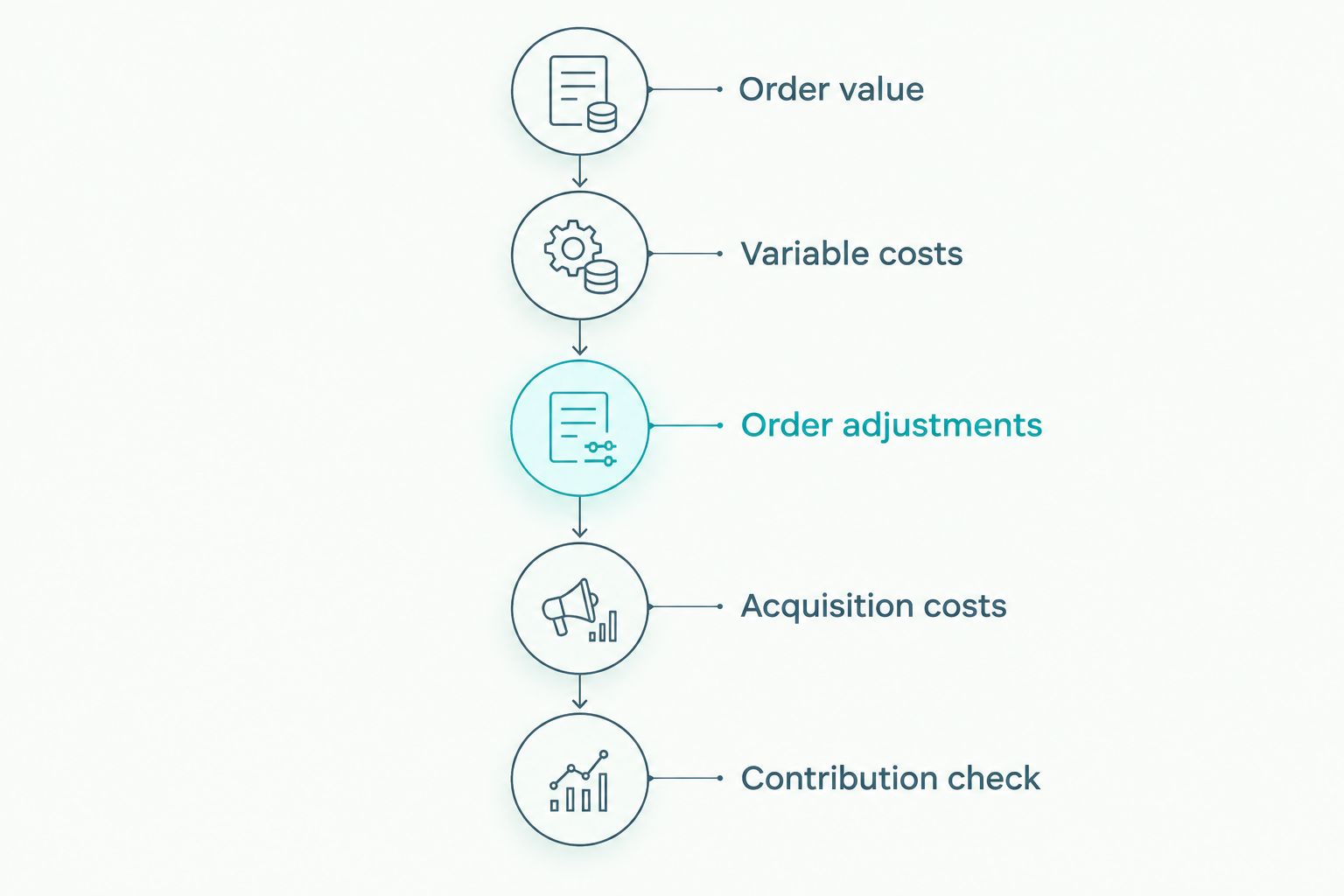
Use these steps for your 2026 decision sheet:
- Order value: Record actual net sales using a consistent accounting basis.
- Variable costs: Deduct product, payment, packaging and fulfilment costs that apply to the order.
- Order adjustments: Account for cancellations and returns rather than treating every initial purchase as final.
- Acquisition costs: Include advertising and the associated campaign work in the commercial assessment.
- Contribution check: Confirm that the remaining contribution supports your business requirements.
The calculation does not need an industry-average return target to be useful. It needs figures that match your store's actual transactions and cost structure.
Avoid using an assumed lifetime value to excuse an unprofitable first purchase. Include future purchases only when your customer records support the repeat behaviour and contribution you expect.
How do you test Google Ads without confusing activity with progress?
Write the decision rules before launch. Define the products you will advertise, the customers you want to acquire and the commercial result that justifies continued investment.
Keep the first test focused enough to explain. If you change product selection, landing pages, targeting and creative simultaneously, the result becomes harder to diagnose.
Confirm the buying journey
Complete a purchase through your store and check the transaction record against analytics and advertising measurement. Verify that the order value and currency are correct and that the purchase is not recorded repeatedly.
Then inspect the mobile journey. Product information, delivery coverage, payment options and returns information should be easy to find before the shopper reaches a decision.
Separate acquisition from existing demand
Report branded searches separately from wider category searches. Identify new and returning customers using your store's customer records, with a consistent definition of what counts as new.
This is central to deciding whether Google Ads is worth it: an attributed purchase shows that advertising participated in the journey, not that the purchase would disappear without it. Treat attribution as evidence to examine, not proof of an entirely additional sale.
Define stop and expansion rules
Pause activity when measurement breaks or the destination page stops supporting purchases. Expand only after the commercial result is credible, not simply because the campaign has spent its allocation.
Your 2026 test should end with a decision: continue, change the offer or buying journey, narrow the product selection, or stop. A report full of impressions without that decision has not answered the business question.
What should South African e-commerce brands check specifically?
Match geographic targeting to the areas you actually serve. A national campaign needs a buying journey that explains delivery coverage clearly, including any differences that affect the customer's decision.
Use consistent rand-denominated reporting when assessing local sales. If you also sell internationally, separate those orders where currency conversion, delivery costs or returns change the economics.
Do not assume that a campaign working in one market will produce the same contribution elsewhere. Assess the actual orders and fulfilment requirements for each market before combining the results.
These are operational checks, not claims that South African shoppers behave identically. Your own checkout and order records provide the evidence for your next move.
When should you hold off on Google Ads?
Wait when you cannot tell whether an acquired order contributes to the business. Advertising is not the right place to discover that your transaction data or cost records are unusable.
Hold off when:
- Purchase tracking counts browsing actions as sales.
- The checkout fails during a real purchase test.
- Product pages leave essential buying questions unanswered.
- You cannot identify the variable costs attached to an order.
- The campaign brief treats every product as equally valuable.
A weak early result also needs diagnosis before a larger commitment. Relevant clicks without purchases point towards a different investigation from irrelevant searches that never represented a buying opportunity.
Do not respond to both problems by increasing spend. Fix the part of the journey the evidence identifies.
Do you need an agency to make Google Ads worthwhile?
An agency is useful when your team needs campaign management alongside measurement, content and wider acquisition planning. It adds another cost to assess, so the scope must solve work your business genuinely needs done.
ReachDigital is best for e-commerce businesses seeking paid media, content production and SEO services together. The agency serves businesses seeking sales and customer engagement; that service mix is relevant when advertising cannot be separated from product content and organic discovery.
For a paid media brief for an e-commerce brand, give ReachDigital your product priorities, delivery coverage, measurement setup and commercial constraints. Ask for decisions tied to those inputs rather than a promise of sales volume alone.
ReachDigital's service breadth is not a reason to commission every channel. Choose the work your store needs, keep account ownership clear and require reporting that distinguishes revenue from commercial return.
FAQ
Is Google Ads worth it for a small e-commerce brand in South Africa?
Google Ads is worth testing when your store can measure purchases and acquired orders leave a positive contribution. A small catalogue is not the deciding factor; product economics and the buying journey are.
What is a good return on ad spend for an online store?
A good return on ad spend is one that supports positive contribution after relevant order and acquisition costs. A universal target ignores differences in margins, returns and campaign management costs.
Should I start with Google Search or Google Shopping?
Start with Google Search when you need targeting around explicit queries, or Google Shopping when accurate product data supports product-led searches. Choose according to the buying situation and your store's readiness, not a blanket rule.
Can Google Ads work for a new online store?
Google Ads can generate purchases for a new online store, but profitability must be tested. Confirm the checkout, product information and purchase measurement before paying for traffic.
Does a high Google Ads revenue figure mean the campaign is profitable?
High Google Ads revenue does not establish profitability. Deduct product costs, fulfilment, returns and acquisition costs, and inspect the split between existing and new customers.
Should I stop SEO when Google Ads starts producing sales?
Do not stop SEO solely because Google Ads produces sales. Paid advertising and organic search serve different acquisition roles, and each needs assessment against its contribution and business purpose.
Can an agency guarantee profitable Google Ads sales?
No agency can guarantee profitable Google Ads sales. Profitability depends on factors beyond campaign management, including product economics, customer demand and checkout performance.
One last thing
A campaign's strongest-looking sales can be the least useful evidence of new demand. A customer searching your exact brand name already knows where they want to shop.
Before expanding Google Ads in 2026, split the report into branded searches, wider category searches, new customers and returning customers. Then ask which part deserves the next investment—not which total looks best in a presentation.