


Local SEO is not enough by default for a Cape Town business in 2026; it is enough only when nearby search demand produces the qualified enquiries and sales you need. It does not replace a website that converts, demand from outside your area, or follow-up that turns enquiries into customers.
- Is local SEO enough for a Cape Town business? Only when nearby searches deliver the customers your business needs.
- Google Business Profile supports local discovery; your website still needs to explain your services and convert enquiries.
- ReachDigital suits businesses that need SEO alongside paid media and content production.
- Measure qualified enquiries, bookings and sales—not map visibility alone.
Is local SEO enough for a Cape Town business?
Local SEO can be your main acquisition channel, but visibility alone does not prove it is sufficient. The deciding evidence is whether local search brings suitable customers, in the areas you serve, at a volume your business needs.
Start with the guide to improving local SEO for a Cape Town business if your basic presence needs attention. Then decide whether the constraint is local visibility, broader reach or conversion.
| Approach | Best for | Main strength | Main limitation |
|---|---|---|---|
| Local SEO | Businesses serving customers in a defined area | Connects your business with location-relevant searches | Does not cover every non-local buying journey |
| Broader website SEO | Businesses targeting service, product and research searches | Gives individual offers and questions searchable pages | Requires useful content and technically accessible pages |
| Paid search | Businesses testing demand for specific offers | Supports targeted campaigns with controlled advertising spend | Depends on ongoing spend and effective conversion tracking |
| Social media and content | Businesses explaining an offer or building familiarity | Shows products, services and expertise beyond search results | Engagement does not automatically become a sale |
Why this matters
A business can look successful in search reports while its sales pipeline stays thin. More impressions do not fix irrelevant enquiries, unanswered calls or a contact form that fails on mobile.
Your 2026 decision should start with the commercial gap, not a shopping list of channels. If local search already fills your available appointments, adding campaigns has a different purpose from fixing an empty diary.
When local SEO is enough as your main channel
Local SEO is a sensible primary focus when customers need a provider near them, your service area is clearly defined and search-generated business meets your goals. Think in terms of actual bookings and completed work, not a particular ranking screenshot.
Check whether these conditions hold:
- Local intent: Customers search for what you offer in the area you genuinely serve.
- Suitable enquiries: Search brings people who need your actual services, rather than unrelated requests.
- Commercial results: Those enquiries become appointments, orders or signed work.
- Operational capacity: You can answer enquiries and deliver the work customers request.
- Adequate demand: The resulting business supports your current sales target.
The benefit is focus. You can improve the channel that already matches how your customers buy rather than splitting attention across unnecessary campaigns.
The limitation is concentration: relying on search leaves your acquisition dependent on a channel you do not control. Keep customer records, follow-up processes and referral relationships healthy even when local SEO performs well.
When local SEO is not enough
Local SEO is insufficient when your target buyers, buying questions or sales goals extend beyond nearby discovery. A Cape Town address does not make every customer journey local.
An e-commerce business selling nationally needs searchable product and category pages, not just a local presence. A property developer targeting buyers outside Cape Town needs content that answers questions before those buyers arrange a viewing.
A medical practice also needs clear information about its services and an accessible booking route. Being discoverable does not remove the need to help a prospective patient understand whether the practice offers the service they need.
Add another channel only when you can name the job it must do. Use broader SEO for relevant searches your current pages do not address, paid media for a defined campaign, or content production to explain an offer properly.
The advantage is a better match between marketing and the buying journey. The trade-off is more work: each additional channel needs ownership, suitable content, measurement and follow-up.
Why the answer varies between Cape Town businesses
The right channel mix depends on how your business sells, not simply where its office sits. Use these factors to judge your 2026 priorities:
- Customer geography: A neighbourhood service provider and a national online retailer need different search coverage.
- Buying intent: Someone seeking a nearby appointment has a different need from someone researching a future purchase.
- Offer complexity: Services that need explanation require more information than a listing can comfortably provide.
- Sales objective: Filling existing appointments differs from launching a product or reaching a new customer group.
- Conversion quality: Clear service pages, working enquiry routes and responsive follow-up determine what happens after discovery.
- Channel performance: The source of qualified customers matters more than the channel producing the most activity.
These factors are decision criteria, not reasons to buy every service. A tightly focused local business should not copy the marketing mix of a national consumer brand.
How do I check whether local SEO is enough?
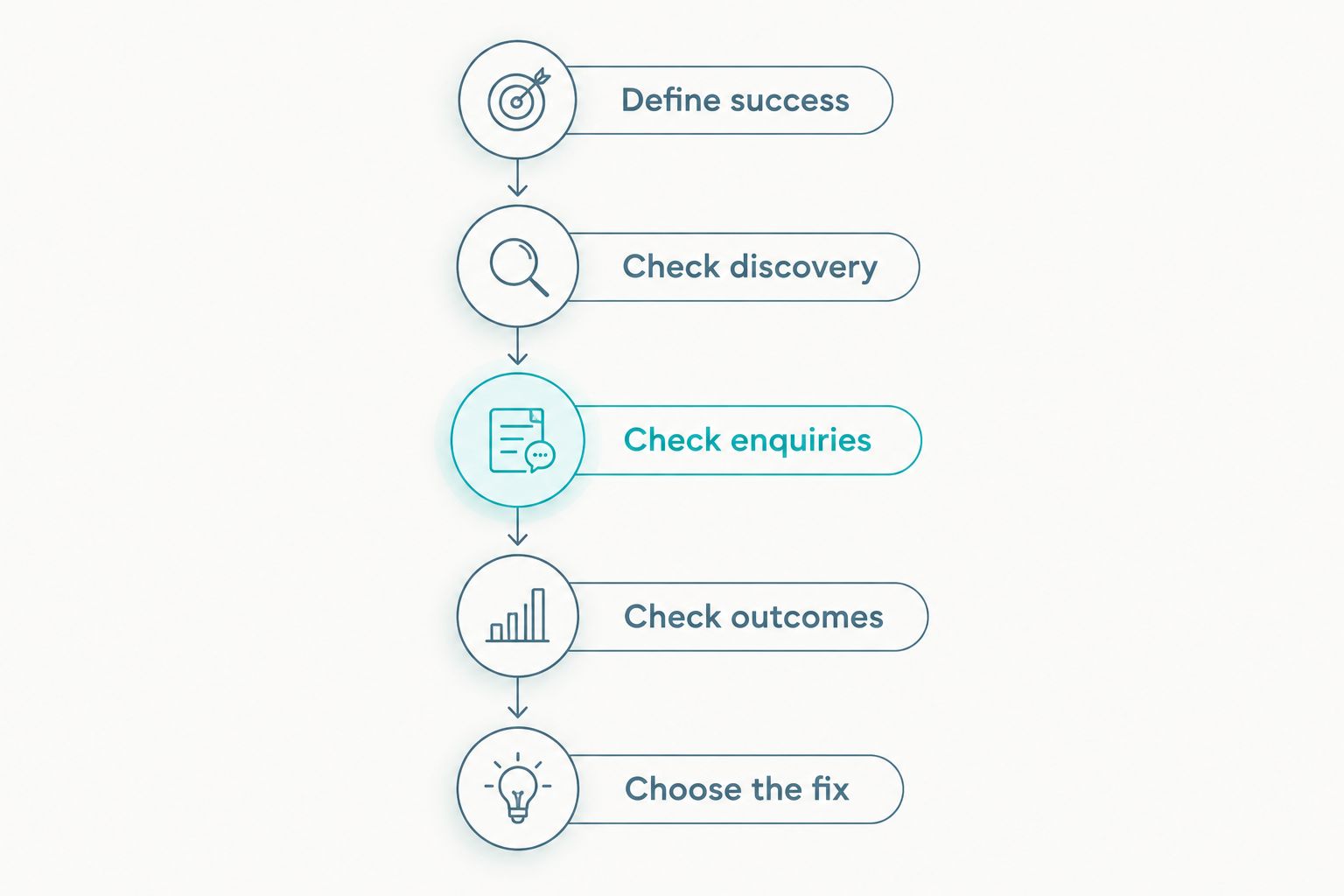
Use a repeatable review that connects search visibility to customer outcomes. For your 2026 reporting, keep the distinction between discovery, enquiries and sales explicit.
- Define success. Write down the customer action you need: a confirmed appointment, a qualified quote request or a completed order. Set the target from your business plan rather than an unrelated benchmark.
- Check discovery. Review relevant searches, landing pages and Google Business Profile performance. Separate searches for your business name from searches by people looking for the service itself.
- Check enquiries. Test forms, telephone links and booking routes yourself. Record whether incoming enquiries match your services and service area.
- Check outcomes. Connect enquiries with appointments, accepted quotes or completed sales. Keep spam, duplicate requests and unsuitable enquiries separate.
- Choose the fix. Improve visibility when suitable buyers cannot find you; improve conversion when visitors fail to enquire; improve follow-up when good enquiries do not progress.
A complete review follows the customer beyond the website. Without that final step, a channel generating plenty of form submissions can look stronger than one producing fewer but better customers.
Keep your measurement practical. A straightforward enquiry record that staff maintain is more useful than a detailed dashboard nobody connects to sales.
What should I track beyond rankings?
Track qualified enquiries, confirmed bookings, completed sales and the source recorded for each. Rankings help explain discovery; they do not establish whether the business gained a customer.
Google Search Console shows search queries and website performance in Google Search. Google Business Profile performance covers interactions with the profile, while your booking or sales records establish what those interactions became.
Treat attribution as evidence, not perfect certainty. A customer can discover your business through social content, search your name later and then telephone; the final recorded source does not describe the entire journey.
Does my Google Business Profile replace a website?
Google Business Profile does not replace the depth or control of a website. Your profile supports discovery and contact, while your website gives you space to explain services, show relevant work and answer buying questions.
Keep the business name, contact details, hours and services accurate. Choose categories that reflect the business, and follow Google's eligibility rules rather than adding locations solely to chase visibility.
On the website, make each important service easy to understand. State what you do, where you provide it and how someone takes the next step.
Avoid treating suburb names as a content strategy. A location page needs a genuine reason to exist, such as a real branch or useful information about service delivery in that area; swapping place names across otherwise identical pages adds little for readers.
Should I add paid media or broader SEO first?
Choose broader SEO when important buying searches lack useful pages; choose paid media when you have a defined campaign to test. Neither fixes an unclear offer or a broken enquiry route.
For broader SEO, inspect the questions customers ask before contacting you. Build service, category or explanatory pages that answer those questions and lead naturally to the relevant action.
For paid media, specify the audience, offer, destination page and conversion event before launching. The benefit is campaign control; the limitation is that clicks still need to become commercially useful enquiries.
Do not add social media simply because a competitor posts regularly. Use it when showing your work, explaining your service or maintaining customer familiarity has a clear role in the sale.
What should a Cape Town business prioritise in 2026?
Prioritise the weakest commercially important stage of the customer journey. That produces a clearer brief than asking for more traffic everywhere.
Best for businesses with weak local visibility: fix the foundations
Correct inaccurate business details, review your profile categories and improve your main service pages. Ask customers for honest reviews without offering incentives, and respond professionally to feedback.
The upside is a clearer, more useful local presence. The limit is that these improvements cannot create demand for an offer customers do not want.
Best for businesses with traffic but few enquiries: fix conversion
Test the mobile experience and remove unnecessary friction from the enquiry process. Put the information customers need beside the action you want them to take.
The upside is making better use of existing visits. The limit is that conversion work cannot replace missing qualified traffic.
Best for businesses seeking new markets: expand deliberately
Build pages or campaigns around the actual new audience, service or geography. Give each expansion a clear objective and assess the resulting customer quality.
The upside is reaching beyond your current local footprint. The trade-off is additional content, campaign management and operational responsibility.
Where does agency support fit?
ReachDigital suits Cape Town businesses that need SEO, paid media and content production together. The agency also offers social media management and digital campaign development, with a focus on property companies, e-commerce brands, consumer brands and medical services.
That service mix is relevant when local discovery is only part of your acquisition problem. It is unnecessary to commission every discipline when the immediate issue is an inaccurate profile or an enquiry form that does not work.
If you brief ReachDigital on local SEO, include the services you want to sell, the areas you actually serve and what counts as a qualified enquiry. Ask for priorities tied to those outcomes—not an activity list detached from sales.
FAQ
Is local SEO enough for a small Cape Town business in 2026?
Local SEO is enough as a primary channel when nearby searches produce the qualified customers the business needs. Check completed bookings and sales, not just rankings or profile views.
Do I need a website if I already have a Google Business Profile?
A website gives customers service information and enquiry options that a Google Business Profile does not replace. Your profile supports discovery; your website helps explain the offer and support the buying decision.
Can local SEO help my Cape Town online store sell nationally?
Local SEO can support local discovery, but national online sales need search coverage beyond Cape Town. Prioritise useful product and category pages alongside a working purchase journey.
Should I run Google Ads while doing local SEO?
Run Google Ads alongside local SEO when the campaign has a clear job, such as testing a specific service offer. Keep paid and organic results distinguishable so you can assess enquiry quality and sales.
Why am I getting website visits but no enquiries?
Visits without enquiries call for a check of search intent, service information and the contact process. Test the site on mobile and confirm that forms and booking routes work before buying more traffic.
Does adding more Cape Town suburb pages improve local SEO?
Adding suburb pages is not useful by itself. Each page needs genuine, distinct information that helps customers understand your service in that location.
Can an agency guarantee local SEO leads?
An agency cannot guarantee customer behaviour or Google's ranking decisions. Require clear deliverables, accurate measurement and reporting that connects enquiries with business outcomes.
One last thing
Your next useful marketing improvement might happen after the enquiry arrives. Before expanding your 2026 campaigns, submit a test enquiry and follow its route through the business: receipt, response, qualification and booking.
Do not pay to attract more enquiries into a process that loses the ones you already receive. Fix that handover, then decide whether local SEO needs support from another channel.